The Ministry of Health has concluded preparations for the 2026/2027 internship cohort. Pre-interns collect their offer letters at Afya House on Monday 29th June before commencing postings across Kenya’s public health facilities one day into July.
COFEK Newsdesk | Nairobi | 27 June 2026
On the first day of July 2026, six thousand three hundred and sixty newly graduated healthcare professionals will fan out across public health facilities in every corner of Kenya.
They will carry with them offer letters collected, in person, from the Ministry of Health Headquarters at Afya House in Nairobi.
They will bring stethoscopes, clinical skills, and years of academic preparation. And they will step into a public health system that needs them urgently.
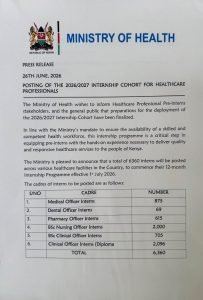
The Ministry of Health announced on 26th June 2026 that all preparations for the deployment of the 2026/2027 Internship Cohort have been finalised.
The twelve-month programme, covering six professional cadres, represents one of the most substantial single deployments of healthcare interns that Kenya has undertaken.
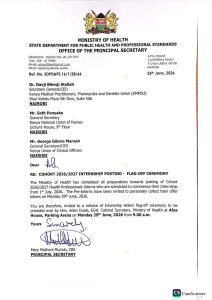
The announcement was made through a press release and accompanied by a formal invitation letter from Principal Secretary Mary Muthoni Muriuki, CBS, to the leadership of the three major health worker unions — the Kenya Medical Practitioners, Pharmacists and Dentists Union (KMPDU), the Kenya National Union of Nurses, and the Kenya Union of Clinical Officers.
Cabinet Secretary for Health Hon. Aden Duale, EGH, will preside over a flag-off ceremony at Afya House Parking Arena on Monday 29th June 2026 from 9.00 a.m. Pre-interns are required to attend in person to collect their offer letters.
The Ministry has made clear that no letter will be issued without a valid National Identity Card. Those who arrive without identification documents will leave without their letters. The message is unambiguous: come prepared.
Six Cadres, One Shared Mission
The 2026/2027 cohort is drawn from across the healthcare professions. Nursing dominates the numbers, with two thousand BSc Nursing Officer Interns being posted — a figure that reflects both the scale of Kenya’s nursing workforce pipeline and the acute shortage of qualified nurses in the country’s public facilities.
Clinical Officer Interns at diploma level account for 2,096 of the total, making them the second largest group and bringing the combined nursing and clinical officer cohort to more than four thousand individuals — over two thirds of the entire deployment.
Medical Officer Interns number 875. They represent the frontline of Kenya’s medical intern class of 2026 — young doctors who have completed their undergraduate training and now begin the supervised clinical practice required before full licensure. BSc Clinical Officer Interns, the degree-stream equivalent, contribute a further 705 to the cohort. Pharmacy Officer Interns account for 615, and Dental Officer Interns, the smallest cadre, number 69.
Together, these six groups form a cohort whose combined clinical presence across Kenya’s health facilities will, for the next twelve months, be a tangible and meaningful component of public healthcare delivery — not a supplement to it.
|
No. |
Cadre |
Interns |
|
1. |
Medical Officer Interns |
875 |
|
2. |
Dental Officer Interns |
69 |
|
3. |
Pharmacy Officer Interns |
615 |
|
4. |
BSc Nursing Officer Interns |
2,000 |
|
5. |
BSc Clinical Officer Interns |
705 |
|
6. |
Clinical Officer Interns (Diploma) |
2,096 |
|
|
TOTAL |
6,360 |
A System That Cannot Afford to Wait
The timing and scale of this deployment carry weight beyond the administrative. Kenya’s public health system has operated below safe staffing thresholds for years. The ratio of doctors, nurses, and clinical officers to patients in public facilities — particularly outside Nairobi — falls well short of World Health Organization benchmarks. Patients in county hospitals routinely encounter long waits, overstretched staff, and facilities where a single nurse covers multiple wards through the night.
In this environment, each intern deployed is not merely completing a training requirement. Each one is a real clinical presence in a real facility serving real Kenyans. The 875 medical officer interns will take on genuine clinical responsibilities in hospitals that are short of doctors. The two thousand nursing interns will staff wards that would otherwise run on skeleton rosters. The 615 pharmacy interns will dispense medication and provide counselling in facilities where pharmaceutical services have historically been thin.
The internship programme is, in this sense, both a training exercise and a workforce intervention. Its successful and timely execution is a matter of consumer interest. Kenyans who rely on public health facilities — and that is the majority of this country’s population — have a direct stake in whether these postings happen on schedule, in appropriate facilities, and with the supervision and support that interns require to learn and to serve effectively.
COFEK’s Position
The Consumers Federation of Kenya welcomes the Ministry’s announcement and the timely finalisation of deployment preparations. We congratulate the 6,360 pre-interns on reaching this milestone after years of rigorous training. Their commitment to the healthcare professions, and their willingness to serve in Kenya’s public system, deserves recognition.
COFEK calls on the Ministry of Health to ensure that postings are made equitably across all 47 counties, with priority given to facilities in historically underserved areas. We further call on county governments to ensure that receiving facilities are adequately resourced — with functional equipment, reliable supply chains, and experienced supervisors — so that interns can fulfil both their training obligations and their service responsibilities.
We will be monitoring the deployment. We will be listening to interns and to the communities they serve. And we will not hesitate to raise concerns if the promises made in this press release are not matched by the reality on the ground from 1st July onwards.
6,360 interns. 47 counties. One objective: quality, responsive, and accessible healthcare