In the predawn hours of a recent morning, the rumble of machinery signaled the end of one of Nairobi’s most contentious public utilities.
The public toilets adjacent to the Kenya National Archives on Moi Avenue — a facility that for decades served thousands of city residents, traders, commuters, and matatu crews daily — were demolished overnight.
The City County of Nairobi framed the move as a step forward. Critics are asking whether it is a step backward.
City Facelift
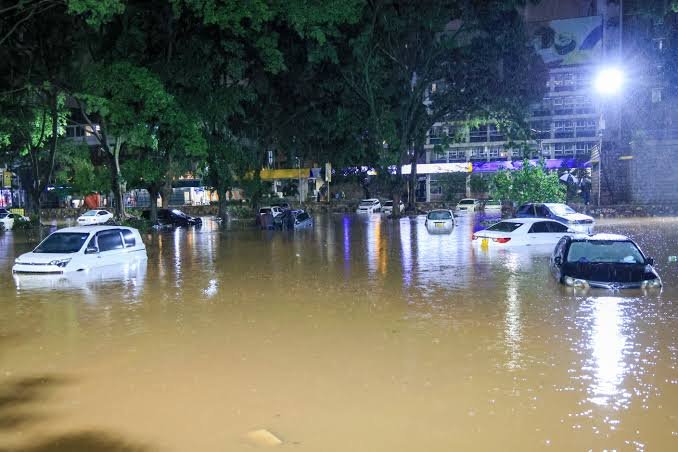
The demolition was presented as part of broader efforts by Nairobi County Governor Johnson Sakaja to modernize the Central Business District (CBD) and mitigate flooding amid intensifying heavy rains. 
The National Archives area had reportedly been undergoing gradual transformation for some time.
For the past two months, Nairobi County had been working on a facelift project at the archives area, including new pavement, installation of chandelier lights, and preparation of spaces for landscaping. 
The demolition fits within a wider urban infrastructure drive tied to Kenya’s hosting ambitions.
Key projects include the 60,000-seat Talanta Hela Stadium, extensive renovations to State House, the 120-metre Junction Mall flyover, and Kamukunji community facelifts, all aimed at modernizing the city for the AFCON 2027 tournament. 
In that context, removing aging sanitation structures near one of the city’s most prominent landmarks appears consistent with a governor eager to project an image of a world-class capital.
Residents and commuters displaced by the demolition were directed to alternative facilities.
Among the affected were shoe-shiners and vendors who had set up stalls in the vicinity, while residents and commuters in the area were told to use facilities at Aga Khan Walkway or the Old Bus Station. 
A History of Chaos
To understand the demolition, one must understand the extraordinary turbulence that has surrounded Nairobi’s CBD public toilets for years.
Far from being a simple public utility, the facilities near the National Archives sat at the center of a multi-million shilling turf war.
The toilets in high-traffic locations could make as much as Sh50,000 per day,  transforming what should be a basic amenity into a lucrative business venture coveted by politicians, youth groups, and cartels alike.
Before 2018, the facilities had operated under a Public-Private Partnership that came into effect in 1999, when the old City Council engaged the business community to find a solution to the deplorable condition of the facilities.
It was former Nairobi Governor Evans Kidero who transferred the management of the toilets to private players, after the county government failed to maintain their hygiene. 
That decision set off a decades-long cycle of competing interests. City tycoons and politicians wanted a piece of the multi-million loo business. 
The violence escalated repeatedly. The standoff that preceded the most recent crisis began when various groups stormed one of the toilets in the CBD, demanding answers on why certain groups continued managing the facilities despite their contracts expiring in November 2024.
The confrontation resulted in injuries to several youths and prompted the intervention of police officers from Central Police Station. 
Cartel Capture
A recurring theme in the history of these facilities is the capture of public utilities by private interests with political connections.
According to Peter Njoroge, spokesperson for the umbrella group “We The People”, things started going wrong in 2018 when cartels brought in by politicians came in. 
During the Nairobi Metropolitan Services (NMS) era, the county reclaimed all 18 public toilets in the CBD, offering free access while the National Youth Service (NYS) maintained them.
However, after Governor Sakaja took office, management was transferred back to various youth and women groups. 
At a church event attended by President William Ruto, Dagoretti North MP Beatrice Elachi revealed that women groups managing the toilets had been earning significant revenues, noting: “We make a lot of money from these toilets, and the governor has given us opportunities.” 
The revenues involved are substantial. On average, one toilet operator disclosed collecting up to Sh60,000 per month, with daily usage reaching 200 customers on slow days. 
Cumulatively, private operators were reported to pay City Hall Sh6.2 million per month, or Sh74.4 million annually, through the Directorate of Environment. 
Sanitation Deficit
The demolition raises urgent questions about what replaces the facility.
Nairobi’s public sanitation infrastructure has long been inadequate for a city of its size. Nairobi has fewer than 200 working public toilets for a CBD that sees over a million people every day. 
The consequences of this deficit are visible and increasingly alarming.
Nairobi County health and environment teams have been collecting evidence of matatu and taxi drivers stuck in endless traffic jams turning to bottles to relieve themselves, tossing them from windows or dumping them in alleys. 
Officials described the situation as “disgusting and dangerous,” with one supervisor holding up a bottle still warm from the sun, telling reporters it was the third one picked up that morning on Kimathi Street alone. 
A veteran rider from stage 23 said he once waited 45 minutes near the National Archives with no relief in sight. “We are human,” he remarked. “The county should give us somewhere clean instead of shouting at us.” 
Flood Mitigation?
Governor Sakaja has also cited flooding as a rationale for the demolitions.
The demolition came after Sakaja announced a major operation to demolish illegal structures along riverbanks and restore natural waterways as part of flood mitigation plans. 
Whether a concrete toilet block adjacent to the Archives meaningfully contributed to CBD flooding is a question urban planners and engineers have not publicly addressed.
Critics suggest the flooding argument — while legitimate in riverside contexts — may be selectively deployed to justify demolitions that serve aesthetic and political goals rather than hydraulic ones.
The National Archives structure sits well away from the Nairobi River corridor, raising questions about how directly flood mitigation logic applies to that specific site.
What Next?
In 2023, Nairobi County’s environment department announced plans to build more toilets to ease the shortage within the CBD and refurbish existing ones to the required standards — but little has since been reported as battles to control the toilets continue year after year. 
The pattern is familiar: demolish, promise, delay, repeat. Unless the county delivers a credible replacement facility — one that is clean, accessible, and free from cartel capture — the demolition of the National Archives toilets risks worsening an already dire urban sanitation situation for the very people a world-class city makeover is supposed to serve.
For Nairobi’s hawkers, matatu operators, tourists, and the urban poor who transit through the CBD daily, a chandelier-lit pavement offers little comfort when there is nowhere left to go.