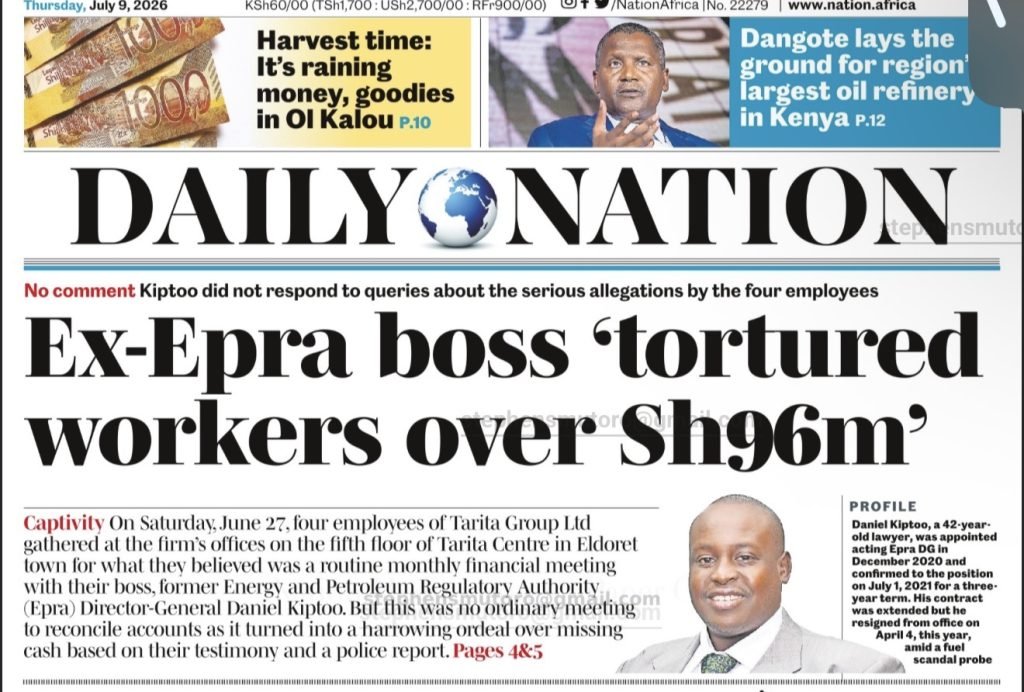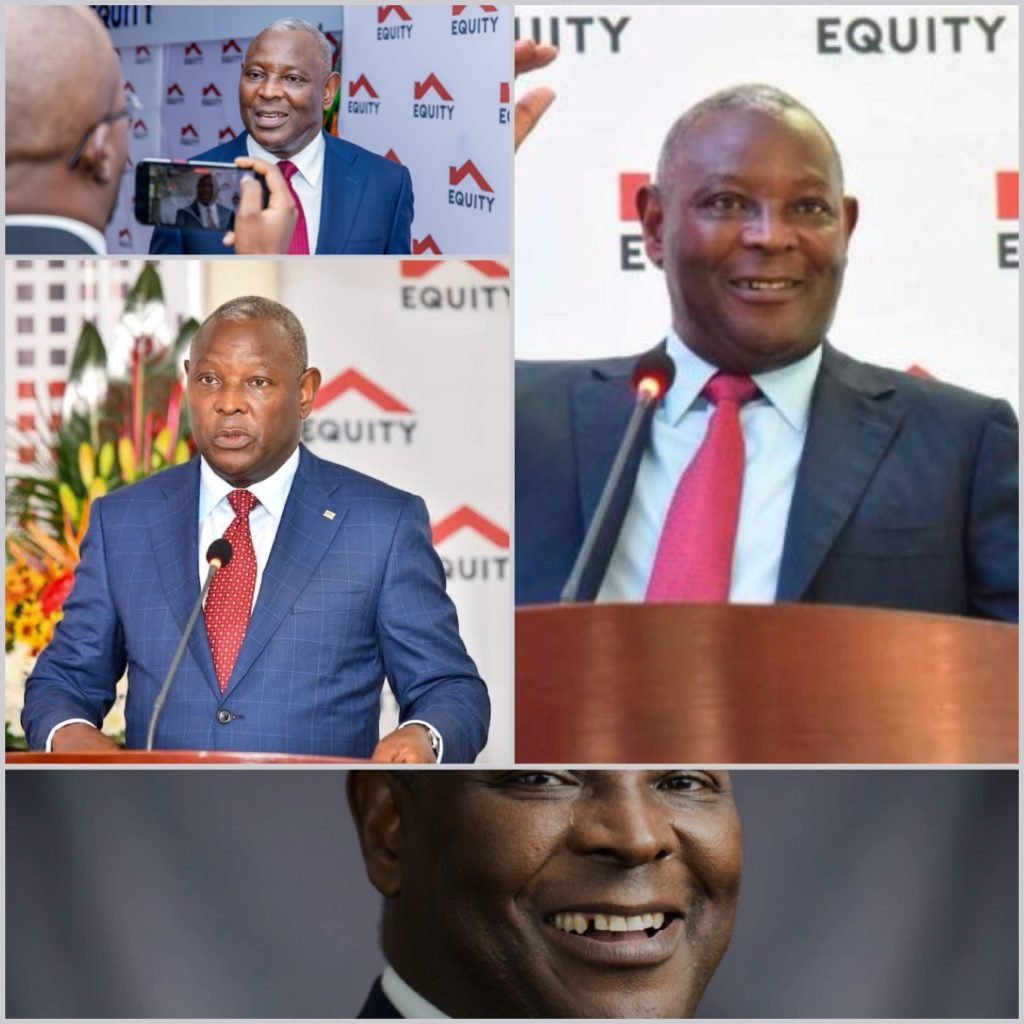
PS’es Belio Kipsang and Chris Kiptoo on March 25, 2026
A special audit has laid bare a trail of suspicious transactions, frozen accounts and unauthorised diversions totalling Sh9.4B through Kenya’s e-Citizen platform
At the centre of the probe stand three powerful figures — a Principal Secretary, an Attorney General and a bank CEO — whose roles, responsibilities and silences raise urgent legal and institutional questions.
Problem
When the Office of the Auditor General tabled its findings before Parliament covering the financial years 2021/2022, 2022/2023 and 2023/2024, the numbers told a disturbing story.
More than Sh9.4B had moved through Kenya’s flagship digital government platform, e-Citizen, in transactions that auditors could not verify, reconcile or fully account for.
The platform, designed to simplify public service delivery and channel revenue directly to the National Treasury, had instead become a conduit for what investigators describe as systematic financial haemorrhage.
Among the most alarming findings: Sh6.3B was diverted from e-Citizen’s Equity Bank collection account into an undisclosed account operated under the name Pesaflow — a private entity.
A further Sh2.6B was collected from Kenyans as convenience fees through irregular mechanisms.
And Sh127.9M was transferred from the official M-Pesa paybill 222222 to four private entities without authorisation.
The Equity Bank collection accounts also received unexplained receipts of Sh68,719,877 and Sh48,142,844 from the same undisclosed Pesaflow account.
Critically, Pesaflow’s bank statements were never produced for audit — a gap that auditors say makes it impossible to determine the full extent of irregular collections.
Parliament’s Public Accounts Committee (PAC) has now summoned the three most consequential figures in this saga: National Treasury PS Chris Kiptoo, Attorney General Dorcas Oduor, and Equity Bank Group CEO James Mwangi.
Each bears a distinct but intersecting accountability burden. Understanding why requires a careful examination of their roles, obligations and the legal frameworks that govern them.
PS Chris Kiptoo, the Custodian
Under Kenya’s Public Finance Management Act (PFMA) 2012, the National Treasury is the apex institution responsible for revenue collection, accounting and the safeguarding of public funds.
As Principal Secretary, Chris Kiptoo sits at the helm of this function — he is, in legal terms, the Accounting Officer for the National Treasury.
Section 68 of the PFMA is unambiguous: an accounting officer is personally responsible for the management and use of funds appropriated to their ministry or department.
The law requires that all public money collected on behalf of the government be deposited promptly into the Consolidated Fund or an approved collection account.
Any deviation from this requirement is a breach of fiduciary duty that the law treats as a serious offence.
The e-Citizen platform was operating under the oversight of the National Treasury. Paybill 206206 — initially used for government revenue collection through Webmasters Kenya Ltd — was configured to transfer collected funds to the National Treasury Settlement Account at KCB Bank every midnight.
But a Presidential Directive and Gazette Notice No. 16008 of December 20, 2022, subsequently designated paybill 222222 as the official government channel, with collections to be auto-transferred to a Settlement Account at KCB Bank.
What the audit reveals is that neither configuration was functioning as it should. Funds were flowing to Equity Bank accounts and to a private entity named Pesaflow rather than to the National Treasury.
Kiptoo’s own admission before the PAC — that a letter was written to Equity Bank requesting account details, and that accounts were subsequently frozen — paradoxically compounds, rather than resolves, his accountability burden.
If the Treasury knew enough to freeze the accounts, the question becomes: why did the irregularities persist long enough to amount to billions?
Legally, Kiptoo cannot shelter behind administrative process. Section 156 of the PFMA criminalises wilful failure by a public officer to perform a duty under the Act.
The PAC’s mandate, derived from Article 229 of the Constitution and Standing Orders of the National Assembly, empowers it to examine accounts and question accounting officers on any matter of financial irregularity.
Kiptoo is squarely within its crosshairs.
AG Dorcas Oduor, the Legal Backstop
The role of the Attorney General in Kenya’s constitutional architecture is multifaceted and uniquely powerful. Under
Article 156 of the Constitution, the AG is the principal legal adviser to the Government. This is not a ceremonial title.
In matters touching on contracts, agency agreements and the legality of government financial arrangements, the AG’s office is the final legal arbiter within the executive.
The e-Citizen scandal implicates the AG’s office on at least two fronts. First, the private service providers — Webmasters Africa Ltd, Electronic Citizen Solutions, Pesaflow Ltd and Goldrock Capital Ltd — were operating under contractual arrangements with government entities.
Any such arrangement involving public funds ought to have passed through, or been sanctioned by, legal frameworks endorsed at the AG level.
That Pesaflow could receive billions in public revenue diversions from e-Citizen without this raising immediate legal red flags at the AG’s office is, at minimum, an institutional failure.
It’s a fraud of monumental proportions to divert public taxes to individuals without parliamentary appropriations.
Second, and more directly, the AG appeared before the PAC and is listed among those who must respond to queries on platform accountability.
Under the Government Contracts Act and the State Corporations Act, the AG’s office carries oversight responsibility over contracts entered into by the government.
If the arrangements with Pesaflow, Webmasters and other entities were procured or structured outside the law — in violation of the Public Procurement and Asset Disposal Act (PPADA) 2015 — then the absence of a legal challenge or advisory opinion from the AG’s office becomes a matter of serious institutional concern.
Experts argue that the AG’s constitutionally enshrined role as protector of public interest — an obligation read into Article 156(4) — demands proactive intervention when public funds are at risk.
The legal standard is not merely reactive. If, as evidence suggests, illegal collection mechanisms were operating at scale for multiple financial years, the absence of a legal intervention or advisory escalation from the AG’s office raises questions about whether the office discharged its constitutional mandate.
James Mwangi, The Banker
Of the three persons of interest, Equity Bank Group CEO James Mwangi occupies the most commercially defined — but no less legally consequential — position.
Equity Bank served as the principal commercial bank through which e-Citizen’s collection accounts operated.
The Auditor General’s report reveals that these accounts received billions in public revenue — including deposits from the undisclosed Pesaflow account — over multiple financial years.
Kenya’s Banking Act, Cap 488, and the Central Bank of Kenya Act impose rigorous Know-Your-Customer (KYC) and Anti-Money Laundering (AML) obligations on financial institutions.
The Financial Reporting Centre Act, 2012, further requires banks to file Suspicious Transaction Reports (STRs) with the Financial Reporting Centre (FRC) whenever transactions raise reasonable concerns about the legitimacy of funds.
The question that will confront Mwangi before the PAC is stark: did Equity Bank at any point file STRs in respect of the anomalous flows in the e-Citizen collection accounts?
The scale of the discrepancy — with Sh68.7M and Sh48.1M appearing in collection accounts from an undisclosed source — meets any reasonable threshold for triggering AML due diligence obligations.
That the Treasury had to write to Equity Bank to obtain account details, and that accounts were only frozen following that request, suggests the bank was not proactively flagging the irregularities.
Under Section 44A of the Banking Act, failure to comply with AML obligations exposes a bank and its officers to regulatory and criminal sanction.
Moreover, Mwangi must answer as accounting officer for the agency relationship between Equity Bank and the National Treasury.
A bank holding public funds in collection accounts has a fiduciary duty not to permit those funds to be diverted without proper authorisation.
The diversion of Sh6.3B to a Pesaflow account — occurring over an extended period — raises the question of whether Equity Bank exercised adequate internal controls, and whether its compliance systems were functioning at all.
The Intersection, is it Fraud?
What makes the e-Citizen scandal particularly difficult to contain is the intersection of public institutional failure and private sector complicity.
The three figures — Kiptoo, Oduor and Mwangi — sit at precisely that intersection. The PS oversaw the platform. The AG was the legal guardian of its contracting framework.
The banker held the accounts through which public revenue flowed and, in critical respects, was siphoned away.
Legal experts note that the standard of accountability for each is different but cumulatively significant.
A PS can be held liable under the PFMA for financial mismanagement.
An AG can face scrutiny under constitutional provisions governing dereliction of duty.
A bank CEO can face regulatory censure and criminal liability under the Banking Act and the Penal Code where gross negligence or complicity in financial crime is established.
The PAC probe, while powerful, is not a criminal court. Its findings, however, can and do trigger referrals to the Director of Public Prosecutions (DPP), the Ethics and Anti-Corruption Commission (EACC) and the Directorate of Criminal Investigations (DCI).
Article 229(8) of the Constitution grants the Auditor General’s reports the status of public documents of record — documents upon which enforcement agencies are empowered to act.
What Next?
The summoning of Kiptoo, Oduor and Mwangi is not the end of the road — it is, or should be, the beginning of a rigorous accountability process. For the probe to have legal and moral credibility, several things must happen.
First, Pesaflow’s complete transaction records must be subpoenaed. The fact that its bank statements were withheld from the Auditor General is itself a potential criminal obstruction.
The FRC should compel disclosure and launch an independent AML investigation into all flows through that account.
Second, the PAC must make formal referrals to the DPP and EACC upon completion of its hearings, with specific recommendations tied to each individual’s institutional role. Accountability must be personalised, not diluted into bureaucratic language about ‘systemic weaknesses.’
Third, Equity Bank’s regulatory standing must be reviewed by the Central Bank of Kenya (CBK).
If compliance failures of this magnitude occurred within a systemically important bank, the CBK has a duty to investigate whether its prudential oversight framework is fit for purpose.
Kenya has been here before. The Goldenberg and Anglo Leasing scandals also began with damning audit reports and parliamentary summons.
In both cases, the machinery of accountability stalled, compromised by political interference and institutional inertia.
The Sh9.4 e-Citizen scandal will be the measure of whether Kenya’s accountability institutions have matured since then — or whether the cycle of impunity continues unbroken.