When regulators collapse an insurer without warning customers, ordinary Kenyans pay the price — literally.
On March 10, 2026, the Insurance Regulatory Authority (IRA) placed Trident Insurance Company Limited under statutory management — effectively pulling the plug on a firm that had been issuing certificates of insurance to paying customers as recently as June 2025.
What followed for thousands of unsuspecting policyholders was not a carefully managed transition.
It was silence, followed by handcuffs.
Trident, founded in 1982 and focused on general insurance covering individuals, motor vehicles and property, had faced repeated complaints over unpaid claims, unmet financial obligations and bounced cheques.
The warning signs were there.
Yet the regulator’s intervention on March 10 came without any direct, proactive communication to policyholders — many of whom only discovered their insurance was worthless when stopped at a roadblock.
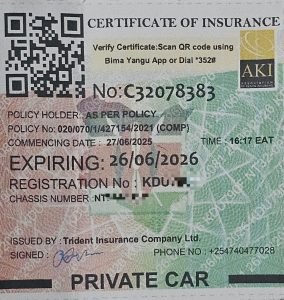
The certificate in question — No. C32078383, issued by Trident Insurance Company Ltd under AKI, Policy No. 020/070/1/427154/2021 (COMP) — was valid on its face, commencing June 27, 2025 and expiring June 26, 2026.
A law-abiding Kenyan paid their premium, received their certificate, and was still arrested for “no insurance.”
That is not the customer’s failure. That is a systemic one.
The IRA’s own public notice instructed existing policyholders to “immediately seek alternative covers from other licensed insurers to ensure there is no unnecessary” gap in coverage.

But how does one act on advice they never received? The notice was published on institutional websites and social media — channels that reach industry players and financial journalists, not the matatu owner in Embakasi or the boda boda rider in Kisumu whose livelihood depends on that piece of paper.
PCF, appointed as Statutory Manager for six months effective March 10, has declared a moratorium on all claim payments and says it will “at an appropriate time, issue a Public Notice on the commencement of compensation to eligible policyholders.”
An appropriate time. Meanwhile, Kenyans are being fined and arrested today.
The compensation framework compounds the injury.
Existing customers must now seek covers from other insurers — at their own cost, for a policy period they already paid for — while awaiting a compensation process that is capped at Sh500,000 per claim and governed by a fund that, as the Auditor-General has just flagged, itself has governance gaps.
Trident did not even file financial results with the regulator in the period leading up to its collapse — a red flag the IRA apparently tolerated long enough for fresh certificates to be issued to unsuspecting Kenyans.
That is a regulatory failure of the first order.
The IRA, PCF and the National Treasury must urgently address three things:
first, a direct SMS or digital notification to every policyholder of any insurer placed under statutory management, using the contact details insurers hold;
second, automatic suspension of traffic enforcement against holders of certificates from collapsed insurers for a defined grace period;
and third, an expedited, above-cap compensation mechanism for motor insurance policyholders who face criminal liability through no fault of their own.
Paying your insurance premium on time should not land you in a police cell. Fix this — now.

Dennis Njagi is listed as the Chief Operations Officer. Beyond that, the names of directors, founders or majority shareholders have not surfaced in any public regulatory filings, media reports, or official disclosures — which is itself a governance concern now that the company is under statutory management.
For the true ownership picture, PCF as statutory manager now has full access to Trident’s books and corporate records.
PCF has assumed full control of the management, business, and operations of Trident Insurance Company Limited for the duration of the statutory management period.
That information may eventually surface through the statutory management or compensation process — but so far, Trident’s owners have remained conspicuously in the shadows, even as their customers face arrests on Kenyan roads.