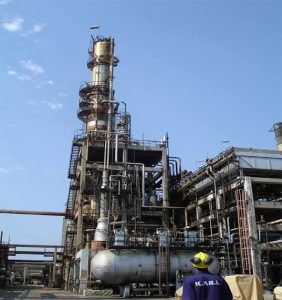
Kenya Petroleum Refineries Limited (KPRL) is insolvent, ungoverned and financially unverifiable, according to a damning Qualified Opinion issued by Auditor-General FCPA Nancy Gathungu covering the year ended 30 June 2024.
The report, spanning nine pages of compounding failures, paints a portrait of a strategic national asset in terminal institutional collapse — kept alive only by government goodwill and creditor patience, while its management serially breaks the law and its books record numbers that nobody can confirm.
The financial position is stark.
KPRL lost Ksh.91.1 million during the year, piling onto a prior year loss of Ksh.464.5 million, with current liabilities of Ksh.4.19 billion crushing current assets of just Ksh.1.70 billion — a Ksh.2.49 billion hole that management chose not to disclose in the financial statements as required by IAS 1.
The Auditor-General was unsparing: the company is insolvent, its ability to continue as a going concern could not be confirmed, and its survival depends entirely on the state and its creditors. That foundational crisis cascades through every line of the financials.
Property, plant and equipment stated at Ksh.1.70 billion cannot be relied upon because assets worth Ksh.2.37 billion — fully depreciated on paper — remain in active use without management reviewing their useful lives or restating their carrying values as required under IAS 16. Intangible assets of Ksh.214.9 million, similarly written off, are also still operational.
The balance sheet is recording assets at values that bear no relationship to reality. Elsewhere, income of Ksh.1.65 billion recorded as Kenya Pipeline Company lease recoveries cannot be confirmed because KPC’s own records show it remitted Ksh.1.81 billion — a Ksh.160 million gap — while also paying Ksh.74.8 million directly to KPRL suppliers in transactions that never appeared in the company’s expenditure records at all.
Trade receivables of Ksh.415 million include Ksh.165.6 million outstanding for over 120 days, among them debts from inactive oil marketing companies and Ksh.61.7 million prepaid for an LPG project that never materialised.
A dollar loan from ABSA Bank for the Captive Power Plant shows a Ksh.11.2 million discrepancy between the company’s records and the bank’s own certificate, unreconciled and unexplained.
Inventories of Ksh.319.5 million — including Ksh.305.7 million in crude and finished product stocks held by KPC on KPRL’s behalf — were reported without a single stocktake during the entire year, with no independent confirmation and no disclosed valuation basis.
Every major balance in the financial statements, in short, is either wrong, unconfirmed or both.
The governance picture is no better. KPRL’s Chief Executive Officer has been serving in an acting capacity since 4 October 2019 — appointed for twelve months, still there five years later, with the Board simply rolling over his tenure in annual extensions in brazen defiance of the
Head of Public Service circular of March 2020 that caps acting appointments at six months. Four other employees were similarly found in acting roles for periods exceeding thirty months.
The Chief Operating Officer, meanwhile, was seconded to the State Department of Petroleum in April 2023 for a further two years despite having already exhausted the legally permitted maximum of six years in secondment since July 2017 — and management, which acknowledged in writing that it was aware of the governing regulations, released him anyway without Public Service Commission approval.
Six out of seven leasehold residential properties owned by the company sit idle, generating no income, despite board approval for their commercialisation dating back to 2016, while the company continues spending on water, electricity and security for the empty buildings.
Procurement of goods, works and services throughout the year was conducted outside the mandatory e-procurement platform in direct breach of the Public Procurement and Assets Disposal Regulations 2020 and National Treasury circulars.
The board overseeing all of this had only five directors against a statutory minimum of seven, lacked a single director with the financial expertise mandated by Mwongozo, included two members who had served over seven years and one who had served ten — all in breach of the six-year consecutive term limit — and routinely failed to achieve quorum for full board meetings.
The company has had no strategic plan since its last one expired in 2013, substituting informal pillars and objectives in violation of the Public Finance Management Act. The internal audit department was left with one officer after its acting head — who had been occupying a position that does not exist in the staff establishment — retired in February 2024.
And when auditors checked on the prior year findings that management claimed to have resolved, no evidence of resolution was produced for a single matter.
KPRL sits at the centre of Kenya’s petroleum infrastructure. That it is being run by an acting CEO entering his sixth year, governed by an inquorate board without financial expertise, with books full of unverifiable numbers, no stocktakes, no strategic plan, no functioning internal audit, and a going concern status the Auditor-General cannot confirm — is not a series of administrative oversights.
It is a governance emergency hiding in plain sight, certified by the state’s own supreme audit institution, and apparently of concern to nobody with the power to act