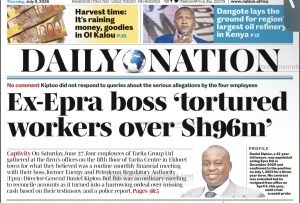
The Consumers Federation of Kenya (COFEK) has closely reviewed the ‘Daily Nation’s front-page and double-spread story of Thursday, 9 July 2026, splashed under the headline “Ex-Epra boss ‘tortured’ workers over Sh96m,” and finds it wanting on the very standards of fairness, verification and evidence that a paper of the Nation’s stature owes its readers.
As Kenya’s principal consumer and public-interest watchdog, COFEK is not in the business of defending individuals — but we are squarely in the business of defending the public’s right to accurate, non-manipulative information.
This story fails that test on multiple fronts.
1. No evidence linking Mr Kiptoo to Tarita Group
The entire narrative hangs on the premise that former Energy and Petroleum Regulatory Authority (EPRA) Director-General Daniel Kiptoo is somehow behind, or benefiting from, Tarita Group Ltd. Yet the paper’s own reporting undercuts this.
By its own admission, Tarita Group Ltd’s shares are held by a Mauritius-registered parent company, with a named Kenyan director who is neither Mr Kiptoo nor a disclosed proxy of his. No shareholding record, no bank trail, no signed agreement bearing Mr Kiptoo’s name is produced anywhere in the piece connecting him to the firm whose internal dispute triggered the alleged “torture.”
A story that stakes its entire premise on an unproven ownership link owed its readers that documentary proof before publication, not after.
2. The substratum of the matter is never settled
A story built around a Sh96 million “missing” sum should, at minimum, establish whether that sum actually went missing, from whom, and how. The article never does this. It reproduces claims — some attributed to an anonymous “source,” others to a police report the paper says it has “seen” — without independently verifying the underlying bookkeeping dispute that supposedly justified the alleged confrontation.
Readers are left with a dramatic allegation of missing money but no forensic or audit basis for the figure itself. A serious financial-crime allegation of this magnitude demands more than a recycled number.
3. An overreliance on hearsay, with no primary verification
The piece is stitched together almost entirely from unnamed and anonymous sources: “a source who requested anonymity,” alleged text messages attributed without independent authentication, and a police report the reporter says was “seen” rather than obtained and referenced by file number.
Crucially;
– None of the four alleged victims is named or quoted on record.
– No medical report is reproduced, cited by facility, or attributed to a named doctor — only an unidentified “independent doctor” is invoked to interpret findings.
– No Occurrence Book (OB) number, police station reference, or charge sheet is cited to allow independent verification of the “six suspects” arrest claim.
This is the textbook definition of hearsay journalism — serious enough to destroy a public figure’s name, yet too thin to survive basic fact-checking scrutiny.
4. Why does EPRA appear in the headline at all?
Mr Kiptoo left EPRA months before this alleged Eldoret incident, and the dispute as reported concerns a private company, Tarita Group Ltd, with no institutional link to EPRA established anywhere in the story. Prefixing the headline with “Ex-Epra boss” when the substance of the allegations has nothing demonstrably to do with his regulatory tenure is not incidental framing — it is a deliberate device to import the authority and public interest attached to EPRA into what is, on the story’s own facts, a private commercial dispute. This is precisely the kind of headline engineering that misleads readers into believing a regulatory scandal is at play when none has been shown.
5. The timing is not politically innocent
This story runs two days before President William Ruto is scheduled to be the chief guest at the Kaptagat Integrated Conservation Programme launch on Saturday, 11 July 2026 — in Keiyo South, the very Keiyo-Marakwet backyard from which Mr Kiptoo hails.
COFEK does not allege coordination, but the coincidence deserves scrutiny rather than silence. It sits within a wider, uncomfortable pattern: Mr Kiptoo is not the first Keiyo-Kalenjin technocrat of the Uhuru Kenyatta era to be publicly hounded out of office under Dr Ruto’s watch.
Former Finance Cabinet Secretary Henry Rotich, also Keiyo, faced a similarly public unravelling. Meanwhile, the same governance failures cited in the exit of Mr Kiptoo and former Kenya Pipeline Company boss Joe Sang have, by wide public commentary, been far more visibly present in the tenure of Energy Cabinet Secretary Opiyo Wandayi — who nonetheless remains in office.
Kenyans are entitled to ask why some officials answer for alleged sins that others, arguably more culpable, are shielded from.
6. A story this one-sided invites the question: whose interest does it serve?
A newspaper of the *Nation’s* institutional weight does not normally run an unverified, single-sourced, hearsay-laden allegation of torture on its front page without the accused’s side, without documentary proof of the central allegation, and without a named victim. When a story departs this sharply from ordinary editorial gatekeeping, it is fair — indeed necessary — for the public and press-accountability bodies to ask whether the piece was independently generated or whether it was placed to serve an interest beyond the newsroom.
COFEK is not asserting that this story was sponsored. We are asserting that its glaring evidentiary gaps make that question a legitimate one, and we call on the *Nation Media Group* and the Media Council of Kenya to clarify the sourcing and editorial process behind it.
7. The stakes go beyond one man’s reputation
How President Ruto is seen to handle the Rotich and Kiptoo episodes — whether as evenhanded accountability or selective ethnic targeting — will not stay confined to Eldoret’s fifth floor. It feeds directly into the political arithmetic of the Rift Valley vote ahead of the 2027 General Election.
A media environment that allows unverified hit-pieces to substitute for due process does a disservice not just to Mr Kiptoo, but to the broader public’s ability to judge these matters on facts rather than manufactured outrage.
COFEK’s Position
COFEK takes no position on Mr Kiptoo’s guilt or innocence in the underlying Tarita Group dispute — that is a matter for the police, the Office of the Director of Public Prosecutions, and ultimately the courts. Our concern is narrower and, we believe, more fundamental: the public’s right to be informed by verified fact, not orchestrated hearsay.
We call on:
1. The Nation Media Group to publish the primary evidence underpinning its claims — the police report by file number, the medical report by facility and physician, and on-record victim testimony — or to issue a correction.
2. The Media Council of Kenya to review the story against the Code of Conduct for the Practice of Journalism, particularly on verification, right of reply based on full details and timing, and sourcing standards.
3. The National Police Service to confirm or deny the existence and status of the OB entries and arrests referenced in the story.
Kenyans deserve accountability journalism built on evidence — not headlines that blur regulatory titles, private disputes, and political timing into a single, unverifiable narrative