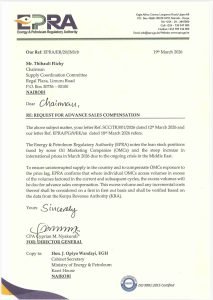
We have seen EPRA’s letter, as copied to you, dated March 19, 2026 in regard for advance sales compensation as addressed to the Industry Supply Coordination Committee under Ref: EPRA/ER/20/JM/rb.
EPRA’s letter confirms it will compensate Oil Marketing Companies (OMCs) for “excess volumes” accessed beyond their allocated cycles — essentially a price lag compensation mechanism triggered by the Middle East crisis driving up international crude prices in March 2026. The compensation figure reportedly stands at Sh11 per litre.
EPRA is not an extension of OMC’s committees. The critical omission: retailers and consumers are left entirely outside this compensation architecture. From the outset, we oppose the said unholy alliance between the regulator in toto largely for the reason that EPRA is usurping a compensatory mandate it neither holds nor can it be competent to exercise fairly if it ever had it. We oppose on the following grounds
Screenshot
A. LEGAL ISSUES
1. EPRA’s Statutory Mandate
Under the Energy Act 2019, EPRA’s mandate is explicitly to protect consumer interests alongside industry stability. Section 9 of the Act requires EPRA to ensure energy is available at reasonable prices. By designing a compensation mechanism that flows exclusively to OMCs — upstream players — without a corresponding consumer protection instrument, EPRA arguably acts in partial breach of its enabling statute. It is legally fatal for EPRA to wear the OMCs uniform while purporting to be neutral arbiters.
- Price Review Timing ProblemThe March 15–April 14 pricing cycle is the legally gazetted window. Any mid-cycle or retrospective compensation that effectively alters the pump price outside the gazette framework could be challenged asultra vires. Consumers and retailers had a legitimate expectation of price stability within that gazzetted period. Compensating OMCs for costs incurred during a period already subject to a regulatory price order creates a legal grey zone. In any case, EPRA has never “compensated” consumers where OMC’s have made unreasonable profits. The “First In First Out” (FIFO) Verification Clause
The offending letter states excess volumes and incremental costs will be handled on a FIFO basis verified through Kenya Revenue Authority (KRA) data. While this sounds procedurally sound, it creates a moral hazard: OMCs are incentivized to over-procure during volatile periods knowing retrospective “compensation” is available. There is no legal ceiling stated in the letter, and no consumer offset obligation attached to receiving the compensation. The perceived unprecedented consumer demand – or panic purchase is unsupported.
4. Retailer Exclusion — Restraint of Trade Risk
Petroleum retailers (petrol station operators) sit between OMCs and consumers. If OMCs receive Sh11 per litre compensation but retailers’ margins remain unchanged, retailers bear the operational cost squeeze — longer credit cycles, working capital pressure, stock risk — without relief. This could constitute a constructive restraint of trade, potentially actionable under the Competition Act (Cap 504) if it distorts the downstream market.
5. Public Finance Management Act Exposure
The envisaged compensation is essentially a contingent government liability. If it is financed through the Petroleum Development Levy or any public fund, the Public Finance Management Act 2012 requires transparent parliamentary appropriation. An administrative letter from EPRA cannot by itself authorize public expenditure of this scale — there is a constitutional accountability gap here. Where is the CS as a policy maker and procedural steps prior to being a regulatory subject matter?
B. ECONOMIC CRITIQUE
1. Inflation Pass-Through Risk
Compensating OMCs for price lag without binding them to not pass costs downstream is economically incoherent. If OMCs receive Sh11 per litre relief but still adjust retail pricing behavior (through informal pricing above the pump price cap, rationing supply, or prioritizing bulk/commercial clients over retail stations), the consumer absorbs the shock anyway. The compensation becomes a private sector windfall, not a public stabilization tool.2. Demand Argument is Questionable
The government’s framing of “unprecedented consumer demand” as a justification is economically weak. Demand for petroleum in Kenya is largely price-inelastic in the short run — people need fuel to commute, transport goods, and run generators. Calling normal inelastic demand “unprecedented” to justify OMC relief is a rhetorical device that misrepresents market fundamentals.
3. Pre-War Stock Depletion Argument
The claim that OMCs exhausted pre-Iran war stocks and now face higher replacement costs is legitimate in principle — this is classic inventory price risk. However, sophisticated OMCs operating in a regulated market are expected to hedge this risk. Kenya’s larger OMCs — Total Energies, Vivo Energy, Rubis — are subsidiaries of global majors with access to hedging instruments. Compensating them fully for a risk they could have hedged is a socialization of private risk, which is anti-market and totally anti-consumer.
4. The Sh11/Litre Figure — Who Bears It?
Kenya consumes roughly 4–5 million litres of fuel daily across petrol, diesel and kerosene. At Sh11 perlitre, the total compensation exposure over even a two-week period runs into billions of shillings. This is a significant contingent fiscal liability, and the letter provides no cap, no sunset clause, and no consumer rebate mechanism.
C. GOVERNMENT-TO-GOVERNMENT (G-TO-G) PROCUREMENT EXPOSURE
This is perhaps the most strategically significant risk. Kenya’s G-to-G petroleum procurement arrangement — primarily with Gulf state national oil companies — was introduced to stabilize supply and reduce ForEx pressure through deferred payment terms. However, it creates several exposures:1. Sovereign Debt Accumulation
G-to-G deals defer payment, meaning Kenya is continuously building short-term sovereign petroleum debt. When international prices spike (as in March 2026), the deferred payment obligation grows without a corresponding revenue buffer — especially dangerous if the Kenya shilling is simultaneously under pressure.2. Reduced Price Discovery
G-to-G procurement bypasses open market tendering, meaning Kenya cannot verify it is getting the best price. During a supply crisis, the counterparty government has pricing leverage. There is no independent benchmark audit mechanism publicly disclosed for Kenya’s G-to-G deals.3. Accountability Gap
Because G-to-G contracts are often classified as diplomatic/sovereign arrangements, they escape normal Public Procurement and Asset Disposal Act (PPADA) scrutiny. Parliament and the public cannot audit whether the terms — including price, volume, and credit terms — are in the national interest. This opacity compounds during a price crisis.4. OMC Compensation Loop
Here is the critical circular exposure: Kenya procures fuel G-to-G at sovereign level, supplies it to OMCs under the Open Tender System (OTS), and then when prices spike, compensates OMCs for the price lag. The government therefore absorbs price risk at both ends — on procurement and on distribution — while the consumer and retailer remain unprotected in the middle. This is a structurally broken risk-sharing model.VERDICT & WIN-WIN THRESHOLD
A fair and legally defensible framework should include the following simultaneously:For OMCs: A capped, audited, time-bound compensation — say, 50% of the claimed Sh11/litre — conditional on documented evidence verified by both KRA and an independent auditor, and only applicable to volumes genuinely in excess of cycle allocations. Compensation should be treated as a repayable advance against future levy obligations, not a grant.
For Retailers: A working capital liquidity facility through the Kenya Development Bank or a designated petroleum stabilization window — not cash transfers, but guaranteed credit lines to weather supply disruption without stock rationing.
For Consumers: EPRA must publish a binding price stabilization commitment — that the Sh11/litre OMC compensation will not appear, directly or indirectly, in the next gazette pump price review. This should be gazetted as a formal consumer protection notice, not just an administrative assurance.
For the G-to-G architecture: Parliament’s Energy Committee should demand a disclosure of deferred payment balances outstanding under all G-to-G arrangements, and an independent price benchmarking exercise against open market alternatives.
EPRA’s letter, while procedurally courteous, is economically one-sided and legally fragile. It protects sophisticated, often multinational OMCs from a risk they could partially have managed themselves, with public funds, under a mandate that legally requires consumer protection.
Without a consumer-side instrument attached to any OMC compensation, EPRA is not regulating the market — it is subsidizing one side of it. That is not regulation. That is capture.
Our demand, therefore, is that the EPRA letter must be recalled in its entirety and government takes advantage of the G-to-G to shield the OMCs without appearing to either bribe them and or unlawfully “compensate” them. Government can compensate the actual ‘force de majure” additional costs – so that the price and margins stabilization is in accord with reasonable regulation. Anything short of this remains illegal and an exploitation of the Kenyan fuel consumers, which will be vigorously resisted. Thank you