 SICPA’s Carcinogenic Fuel Markers — The Case for Ministry of Health Intervention
I. THE EXPANDED CONTAMINATION THREAT
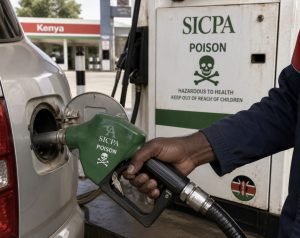
Independent laboratory tests commissioned by COFEK at Conti Testing Laboratories in Bethel Park, Pennsylvania found a significant presence of carcinogenic halogenated bromides in transit fuel and fuel destined for regional markets, raising concerns over exposure within the broader East African supply chain.Critically, the same carcinogenic compounds were detected in fuel diverted to the local Kenyan market, meaning unsuspecting consumers are already being exposed through everyday fuel use across pump stations nationwide.
Independent laboratory tests commissioned by COFEK at Conti Testing Laboratories in Bethel Park, Pennsylvania found a significant presence of carcinogenic halogenated bromides in transit fuel and fuel destined for regional markets, raising concerns over exposure within the broader East African supply chain.Critically, the same carcinogenic compounds were detected in fuel diverted to the local Kenyan market, meaning unsuspecting consumers are already being exposed through everyday fuel use across pump stations nationwide.
Unmarked domestic fuel samples tested clean, pointing directly to the SICPA SA fuel marking process as the source of contamination.
COFEK has also flagged the detection of ethylene dibromide — a substance classified internationally as hazardous — in the fuel supply chain.
The threat is not static. The total volume of marked fuel rose by 11.7% in the 2023–2024 financial year, reaching 3.6 billion litres — meaning with each contract extension, the volume of potentially contaminated fuel injected into the Kenyan and East African supply chain grows.
II. REGIONAL EXPOSURE — EAST AFRICA IS NOT ISOLATED
COFEK has noted that similar fuel marking systems are already deployed in domestic markets in Uganda and Tanzania. The confirmation of carcinogenic compounds in Kenya-marked fuel raises urgent regional public health questions that demand coordinated scrutiny across East Africa.
SICPA marks over 60 billion litres of petroleum products per year globally, with Uganda, Tanzania, and Saudi Arabia among its key markets. East Africa is therefore not incidental to SICPA’s operations — it is a primary deployment theatre.
III. THE EU DOUBLE STANDARD — WHAT EUROPE KNOWS, AFRICA IS NOT TOLD
This is the most damaging indictment. Many fuel markers on the market contain harmful additives which have negative impacts on the performance and emissions of car engines or even on the health of the officials handling them. The European Commission has, precisely because of these concerns, periodically initiated review processes to validate fuel marking technologies against the latest scientific developments — a rigorous safeguard that simply does not exist in Kenya’s regulatory framework.
This is the most damaging indictment. Many fuel markers on the market contain harmful additives which have negative impacts on the performance and emissions of car engines or even on the health of the officials handling them. The European Commission has, precisely because of these concerns, periodically initiated review processes to validate fuel marking technologies against the latest scientific developments — a rigorous safeguard that simply does not exist in Kenya’s regulatory framework.
Meanwhile, SICPA refuses to disclose what is in its markers in Kenya.
EPRA has never published the chemical composition of the marker, commissioned or released an independent toxicological assessment of its combustion by-products, or subjected the health claims around the system to external peer review.
SICPA’s General Manager in Kenya has stated the company could not comment on dosage, composition or other elements in its markers, as public disclosure would affect the security of its technology.
In other words: Europe scrutinises and regulates. Africa is expected to trust and comply.
In other words: Europe scrutinises and regulates. Africa is expected to trust and comply.
IV. CANCER IN KENYA AND EAST AFRICA — A CRISIS THAT CANNOT ABSORB MORE RISK
The baseline cancer burden in Kenya is already alarming. In 2020 Kenya reported 42,000 new cancer cases and 27,000 cancer-related deaths. Cancer is the third leading cause of death in Kenya.
The baseline cancer burden in Kenya is already alarming. In 2020 Kenya reported 42,000 new cancer cases and 27,000 cancer-related deaths. Cancer is the third leading cause of death in Kenya.
The cancer incidence burden in sub-Saharan Africa is expected to rise to over 85% of the global burden by 2030. Against this backdrop, the deliberate or negligent introduction of carcinogenic halogenated bromides into billions of litres of fuel breathed as exhaust by millions of Kenyans — matatu commuters, boda boda riders, petrol station attendants, schoolchildren near highways — constitutes an aggravating environmental and public health emergency.
Scientific research confirms the trajectory: PAH-associated lung cancer risk in Africa increased by 30–64% from 2008 to 2050, due to increasing residential energy demand and the continued use of traditional biomass. Due to more stringent air quality policies in developed countries, their PAH lung cancer risk substantially decreased by approximately 80% from 2008 to 2050.
The divergence is stark — Europe’s cancer risk from combustion products is falling; Africa’s is rising. Introducing additional brominated carcinogens from fuel marking into this environment is not a technical footnote — it is a public health catastrophe in slow motion.
V. WHY THE MINISTRY OF HEALTH PUBLIC HEALTH DIRECTORATE MUST ACT NOW
The Ministry of Health’s Public Health Directorate has constitutional and statutory standing — and a duty — to intervene on four grounds:
The Ministry of Health’s Public Health Directorate has constitutional and statutory standing — and a duty — to intervene on four grounds:
1. Independent Chemical Assessment. EPRA’s promotional defence of SICPA cannot substitute for an independent toxicological assessment of marker combustion by-products. The Ministry of Health must commission one immediately, covering petrol, diesel, kerosene and all other marked products.
2. East Africa Coordination. The Ministry must formally engage counterpart health ministries in Uganda and Tanzania to align responses, share the Conti Laboratory findings, and jointly demand full chemical disclosure from SICPA regarding the markers deployed across the region.
3. Fuel Category Expansion. The contamination is not limited to one product. The fuel marking contract entails application of chemical tracers on petrol, diesel, and kerosene once they are imported into the country. All three — and any other products added under future contract extensions — must be independently tested.
4. The Europe vs. Africa Standard. The Ministry must formally demand from SICPA SA disclosure of whether the chemical formula of the markers deployed in Kenya and East Africa is identical to, or different from, markers deployed in European jurisdictions subject to EU scrutiny.
If they differ, this constitutes discriminatory and exploitative conduct against African consumers — actionable under the Consumer Protection Act and Kenya’s constitutional consumer rights framework.
VI. THE CORE ARGUMENT IN ONE PARAGRAPH
A Swiss firm convicted of paying bribes in three countries, awarded Kenya’s fuel-marking contract through a single-sourced political directive, has for three years injected undisclosed chemical markers into billions of litres of fuel consumed by tens of millions of Kenyans and East Africans. Independent American laboratory tests commissioned by COFEK have confirmed the presence of carcinogenic halogenated bromides in that fuel. The same firm operates in Europe under regulatory scrutiny that demands chemical transparency and health safety validation — scrutiny it has not been subjected to in Africa. Kenya’s cancer burden is already catastrophic and rising. The Ministry of Health Public Health Directorate cannot wait for EPRA — headless, compromised, and conflicted — to act. It must step in, assert jurisdiction over public health, and close the regulatory gap that SICPA has exploited.
A Swiss firm convicted of paying bribes in three countries, awarded Kenya’s fuel-marking contract through a single-sourced political directive, has for three years injected undisclosed chemical markers into billions of litres of fuel consumed by tens of millions of Kenyans and East Africans. Independent American laboratory tests commissioned by COFEK have confirmed the presence of carcinogenic halogenated bromides in that fuel. The same firm operates in Europe under regulatory scrutiny that demands chemical transparency and health safety validation — scrutiny it has not been subjected to in Africa. Kenya’s cancer burden is already catastrophic and rising. The Ministry of Health Public Health Directorate cannot wait for EPRA — headless, compromised, and conflicted — to act. It must step in, assert jurisdiction over public health, and close the regulatory gap that SICPA has exploited.