Screenshot
Re: “How fuel marking technology protects public health and regional energy security”
The Standard, April 28, 2026 — Byline: Thuo Njoroge
Preliminary observation: This is an advertisement, not journalism
The article appears under The Standard’s “National” section with a named byline, yet The Standard’s own navigation lists “Branding Voice” as its paid advertorial category. SICPA has paid a Kenyan newspaper to run corporate propaganda dressed as news reporting — on the very days after COFEK’s constitutional petition is live and active in Court. This is a panicked, last-resort paid counter-narrative by a company facing criminal prosecution, contract suspension, and deregistration. Now to the lies, one by one.
LIE 1: “The markers comply with the European Union’s strict REACH regulations”
This is demonstrably, verifiably false. REACH — Registration, Evaluation, Authorisation and Restriction of Chemicals — places the burden of proof squarely on companies. To comply, companies must identify and manage the risks linked to the substances they manufacture and market in the EU, demonstrate to ECHA how the substance can be safely used, and communicate risk management measures to users.
REACH compliance is not self-declared. It is registered, documented, and publicly searchable in the ECHA database. Registration applies to substances on their own, substances in mixtures, and certain cases of substances in articles — and is based on the “one substance, one registration” principle, requiring manufacturers and importers of the same substance to submit jointly.
The critical fact SICPA omits: SICPA is a Swiss company. Switzerland is not an EU member state. REACH applies to substances manufactured or imported into the EU/EEA. There is no publicly available ECHA registration dossier for SICPA’s proprietary fuel marker. The marker’s precise molecular composition is, by SICPA’s own admission, “patented and undisclosed.” A substance whose identity is secret cannot simultaneously hold a valid REACH registration — because REACH registration is a public record.
Furthermore — and this is fatal to SICPA’s entire REACH claim: The European Commission selected Dow’s ACCUTRACE™ Plus Fuel Marker as the new common fiscal marker — the “Euromarker” — for tax-rebated fuels across the EU. The decision followed extensive independent technical and safety assessments by the Joint Research Centre (JRC) and the Scientific Committee on Health, Environmental and Emerging Risks (SCHEER). ACCUTRACE™ Plus contains only elements commonly found in petroleum derivatives — carbon, hydrogen and oxygen — and explicitly does not present the dioxin-emitting or corrosive properties of halocarbons, nor the health risks associated with some metals.
That is a direct technical indictment of halogenated/bromide-based markers — the very type COFEK has flagged in SICPA’s Kenyan system. The EU chose a different company, with a different chemistry, specifically to avoid what COFEK is now alleging. SICPA does not hold the EU fuel marking contract. It is Dow, not SICPA, that was appointed by the European Commission to supply the EU fiscal marker.
SICPA’s claim of REACH compliance is not only unverifiable — it is contradicted by the EU’s own procurement decision to reject halocarbon-type markers.
LIE 2: “In continuous use for up to a decade across ten different markets in Europe… with no documented harm”
Europe” is a smokescreen. Name the countries. Name the contracts. SICPA claims European deployment as a credibility shield. SICPA says it has been deploying its Fuel Integrity Solution in Europe, Asia, Africa and the Middle East since 2016 — but conspicuously names no specific EU member state with a live fuel marking contract. This is deliberate vagueness. The EU’s fiscal Euromarker — the continent’s primary fuel marking mechanism — belongs to Dow, not SICPA.
SICPA may operate in non-EU European territories, but invoking “Europe” to imply EU regulatory endorsement is misleading at best, and fraudulent at worst when used to deflect from a public health emergency in Kenya.
“No documented harm” is also a non-standard. Absence of documentation is not evidence of safety — particularly where the marker’s chemical composition has never been published, no independent combustion study has been released, and EPRA has never commissioned a toxicological review of combustion by-products.
LIE 3: “Tested by internationally accredited laboratories, including Eurofins and Socotec”
Eurofins and Socotec are legitimate testing houses. But the question is what they tested, under what conditions, and whether those reports are publicly available. SICPA commissioned those tests. SICPA controls what they test. Testing a marker in its injected, pre-combustion state for stability and non-toxicity says nothing about what it becomes at 600°C inside a vehicle engine.
COFEK’s entire allegation is about combustion by-products — the thermal decomposition products of a brominated organic compound under high-temperature conditions. That is a separate scientific question that Eurofins and Socotec have apparently never been asked to answer — because SICPA has never publicly released a combustion toxicology study.
COFEK, by contrast, sent samples to Conti Testing Laboratories, Bethel Park, Pennsylvania — an independent, internationally accredited facility it selected, not SICPA. The results speak for themselves.
LIE 4: “Regulatory bodies worldwide, including EPRA, apply stringent selection criteria and pre-approval testing”
The article itself acknowledges “earlier, less sophisticated marking solutions that later were recognized as carcinogenic and environmentally risky.” It confirms that fuel markers can be carcinogenic if they contain halogens and that the industry has a documented history of deploying chemicals later found to be harmful.
EPRA never published any pre-approval toxicological assessment of SICPA’s marker. Even worse, EPRA upon pressure changes the terms of reference of the tenders by deleting the ban of halogens to allow SICPA to bid! The Sh2.35 billion contract was awarded then through a single-bidder process in June 2022 — the antithesis of competitive, transparent procurement.
LIE 5: “The article presents EPRA as a credible, functioning regulator”
At the time this article was paid for and published, EPRA’s own Director General was under arrest, detained by the DCI in connection with the petroleum scandal COFEK has been separately pursuing. EPRA is effectively headless. Citing EPRA’s endorsement as a safety guarantee is a circular defence built on a collapsed institution. EPRA is either an accomplice and or an accessory to SICPA crimes-against-humanity syndicate, criminally-speaking
Conclusion: What this article really is
A convicted company — fined CHF 81 million by Swiss federal prosecutors for systematic bribery of government officials — has space to run a defensive advertorial on the day its contract faces judicial scrutiny.
It invokes a REACH compliance it cannot prove, cites a European presence it has not substantiated, references a regulator currently under criminal investigation, and claims laboratory safety validation without releasing a single combustion toxicology study.
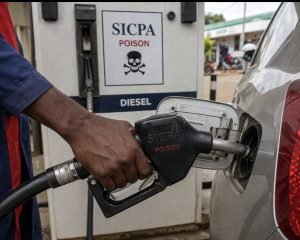
Screenshot
This is not public interest communication. It is the conduct of a corporation that knows what the US lab results will show — and is spending money to shape the narrative before they arrive.
COFEK invites The Standard to immediately label this online content as paid advertising and invites SICPA to publish, without redaction, the full chemical composition of its Kenyan fuel marker and any combustion by-product studies it holds.
Consumer health and safety is a constitutional right under Article 46. SICPA must stop terrorizing African consumers on what they can’t be allowed to do in Switzerland