COFEK exposes how the Ksh 154.2 billion JKIA modernisation contract was secretly awarded to a consortium involving China Road and Bridge Corporation — whose parent was debarred by the World Bank for fraud — and IMC Construction Kenya, a company linked to Wicknell Chivayo, a man with a 2004 fraud conviction and a trail of stalled billion-dollar projects across Southern Africa. The government signed the contract on 23 June 2026 even as a High Court constitutional petition challenging the deal remained live. COFEK will pursue conservatory orders to suspend implementation.
I. THE SCENE OF THE CRIME: JKIA AND KENYA’S RECURRING AIRPORT CURSE
Jomo Kenyatta International Airport is not merely an airport. It is the economic lung of the East African region, handling over seven million passengers annually and serving as the gateway through which Kenya connects to global trade, tourism, and diplomacy. When this asset is mismanaged — or worse, handed over to unfit and opaque interests — every Kenyan consumer pays the price in higher ticket levies, degraded services, and long-term public debt obligations.
Kenya has been here before. In 2024, the Ruto administration negotiated in secret with India’s Adani Group for a controversial public-private partnership that would have handed the Indian conglomerate landing fees and airport revenues for decades.
After the United States Department of Justice indicted Gautam Adani in November 2024 on bribery charges, and following sustained public outrage, the government was forced to cancel that deal.
Kenya Airports Authority (KAA) confirmed on 3 March 2026 that the Adani arrangement had been formally terminated, and there were no ongoing discussions with the Group or its affiliates.
On that same day — 3 March 2026 — the government opened a new international tender under reference Tender No. SDAAD/OT/001/2025-2026, issued by the State Department for Aviation and Aerospace Development.
Bids closed on 14 May 2026. More than 40 firms attended a pre-bid conference in April. Yet from the moment the tender was opened to the day the contract was signed on 23 June 2026, the public, parliament, and Kenya’s apex consumer body were kept almost entirely in the dark.
The lesson of the Adani scandal was never learned. What followed was a repeat of the same concealment, the same contempt for public participation, and the same insertion of disqualified and controversial interests into one of the nation’s most sensitive infrastructure assets. COFEK will not be silent.
II. WHAT WAS CONTRACTED AND WHAT IT WILL COST
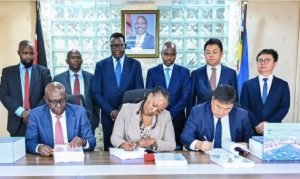
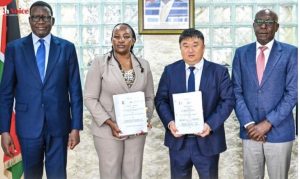
On 23 June 2026, Aviation and Aerospace Development Principal Secretary Teresia Mbaika signed the JKIA expansion contract on behalf of the Government of Kenya.
The counterpart signatory was Yu Xiaodong, General Manager of China Road and Bridge Corporation (CRBC). Transport CS Davis Chirchir announced the signing publicly, describing it as a major national infrastructure investment.
The government’s official figure for the contract is Ksh 154.2 billion (approximately USD 1.2 billion), to be financed largely through credit from development finance institutions, with the state contributing equity of approximately Ksh 50 billion.
CS Chirchir cautioned that the final cost could shift depending on exchange rate movements — a caveat that opens the door to significant cost escalation at the expense of Kenyan taxpayers.
However, the government’s own project documents, multiple independent analyses, and sources with direct knowledge of the arrangement have consistently reported a total project value of Ksh 375.4 billion (USD 2.9 billion) — encompassing not just the EPC construction contract but the full scope of the Integrated Master Plan, which extends to airport-city developments, commercial infrastructure, land-use planning, and long-term expansion works. COFEK’s petition before the High Court places that total public obligation at Ksh 375 billion.
The scope of works as described by the Ministry includes construction of a new passenger terminal designed to handle 15 million passengers annually (tripling current capacity from 7.5 million), a second runway to raise aircraft arrival capacity from 25 to 31 per hour and prevent full airport shutdowns during incidents, modernisation of existing facilities, upgrades to both airside and landside operations, and development of cargo handling and supporting infrastructure.
Alongside this, the government has sharply increased the international passenger departure levy to USD 50 per ticket, ring-fenced to service the loans financing the construction. Every international traveller departing JKIA — tourist, business visitor, Kenyan diaspora — will now directly underwrite a project whose beneficiaries, contractual terms, and ownership structures remain hidden from public view.
“Signing a contract does not sign away the Constitution. Our petition remains firmly before the High Court and is unaffected by this signing.” — COFEK Secretary-General Stephen Mutoro, 23 June 2026
III. THE CONSORTIUM: TWO ENTITIES WITH DISQUALIFYING HISTORIES
The contract names CRBC as the primary contractor, operating as a subsidiary of the China Communications Construction Company (CCCC). COFEK’s investigation has established the following facts about both entities and their Kenyan track record:
CCCC and the World Bank Debarment. In 2009, the World Bank formally debarred CCCC — then operating as its predecessor entity — for fraudulent activity consisting of collusive bidding on World Bank-funded road projects in the Philippines.
The World Bank’s debarment findings are a matter of public international record. CCCC has consistently argued that this debarment is irrelevant to non-World Bank-funded projects. Kenya’s procurement law takes a different view: the Public Procurement and Asset Disposal Act requires that procuring entities conduct due diligence on the integrity and track record of prospective contractors.
A finding of fraudulent collusion by the world’s largest development institution is not a minor procedural footnote — it is a red flag that demands rigorous verification before any government entity signs a contract worth hundreds of billions of shillings.
CCCC and Tax Evasion in Kenya. More directly, in August 2024, Kenya’s Tax Appeals Tribunal upheld a Kenya Revenue Authority assessment ordering CCCC to pay over Ksh 1.047 billion for running a ‘missing trader’ tax evasion scheme on Kenyan soil. The tribunal found that CCCC had claimed inflated input VAT for purchases that had not been incurred, using fictitious invoices from shell companies with no known physical addresses.
Investigators found that some of the purported ‘directors’ of these shell firms had left Kenya years before the invoices were issued. This judgment was fresh at the time the JKIA tender was being evaluated. COFEK is entitled to ask: was this Ksh 1 billion tax evasion finding disclosed during evaluation? Was it treated as a disqualifying factor? If not, why not?
CRBC and the Standard Gauge Railway. CRBC is the contractor behind Kenya’s Standard Gauge Railway, the Nairobi Expressway, and the Talanta Stadium — projects whose procurement processes, cost overruns, and debt obligations have themselves attracted sustained public criticism.
While CRBC has delivered physical infrastructure in Kenya, its track record as a contractor cannot be separated from the opaque government-to-government financing arrangements that have accompanied its projects, arrangements that have repeatedly bypassed open competitive procurement and burdened Kenyan taxpayers with non-transparent debt obligations.
IMC Construction Kenya and Wicknell Chivayo. COFEK has established, through investigative reporting by ZimLive, Kenya Insights, and corroborating sources within CCCC, that IMC Construction Kenya Limited — listed as a joint-venture partner in the consortium — is wholly owned by Wicknell Munodaani Chivayo, a Zimbabwean businessman.
The government, through CS Chirchir, has denied that IMC Construction Kenya is part of the consortium, stating on 18 June 2026 that ‘the company referred to in those reports did not participate in this procurement process as a bidder and has no role, involvement or association whatsoever with this project.’
However, Chirchir conspicuously refused to name the company or consortium that was awarded the contract — a refusal that itself constitutes a violation of the public’s constitutional right to information on the management of public resources.
IV. WICKNELL CHIVAYO: THE PROFILE KENYA DESERVES TO KNOW
Wicknell Munodaani Chivayo, born 22 November 1982, is the founder and managing director of Intratrek Zimbabwe (Private) Limited and the purported owner of IMC Construction Kenya Limited. He is publicly known in Zimbabwe and increasingly across the continent for his flamboyant philanthropy — distributing luxury vehicles, cash, and gifts to musicians, soldiers, footballers, and journalists — and for his unusually close access to heads of state, including Zimbabwean President Emmerson Mnangagwa and, since 2022, Kenyan President William Ruto.
COFEK does not comment on Chivayo’s lifestyle. COFEK comments on his public record as it relates to Kenya’s procurement obligations.
Criminal conviction (2004). Chivayo was convicted in 2004 of theft by false pretences involving approximately R837,000 arising from a foreign currency transaction in which he received money but did not complete his side of the exchange. He served a custodial sentence in Zimbabwe. This is a matter of public record confirmed by multiple sources including Wikipedia and Pindula.
The Gwanda Solar Project. In 2015, Chivayo’s company Intratrek Zimbabwe was awarded a contract valued at approximately USD 172–200 million to construct a 100-megawatt solar power plant at Gwanda, Matabeleland South, by the Zimbabwe Power Company (ZPC). Intratrek received an advance payment of USD 5 million. No substantive construction work was carried out. Parliamentary committees found that advance payment certificates had been issued without corresponding progress, and that the advance had been paid without a required Advance Payment Guarantee.
As of the date of this report — eleven years after the first cheque was cashed — the Gwanda solar plant remains unbuilt. Criminal charges of fraud and money laundering were brought against Chivayo, and while he was ultimately acquitted in 2024 after multiple rounds of prosecution and appeal, the solar plant’s absence speaks for itself.
The Zimbabwe Electoral Commission Scandal. In June 2024, leaked audio recordings emerged in which a voice attributed to Chivayo was heard discussing the distribution of proceeds from a USD 100 million contract awarded to supply election materials to Zimbabwe’s Electoral Commission ahead of the August 2023 general election.
The Zimbabwe Anti-Corruption Commission investigated and announced in December 2025 that it had found no direct evidence linking Chivayo to the transaction. The investigation’s outcome does not eliminate the public concern; it documents it.
The Kenyan Passport. In February 2026, activist Boniface Mwangi publicly disclosed a list of foreign nationals who had received Kenyan passports — and Chivayo’s name appeared on it. The government has not explained the basis on which a Zimbabwean businessman with a fraud conviction and multiple unresolved public contract scandals was granted Kenyan citizenship.
The Kenyan opposition has noted the timing: Chivayo received his Kenyan passport weeks before the JKIA tender was opened, and barely months before Kenya begins preparations for the 2027 general elections.
The State House Access. Chivayo has publicly posted photographs and videos of at least three meetings with President Ruto: at Sagana State Lodge in January 2026, at State House Nairobi in 2025, and at the newly built Wajir State Lodge on 1 June 2026 — the day after Madaraka Day — where he described himself as in discussions with the President about an unspecified multimillion-dollar investment project.
On 15 June 2026, ten days before this article was filed, Chivayo met President Ruto at State House again and praised him effusively on social media. The JKIA tender had already closed. The contract was about to be signed.
No airport construction experience. IMC Construction Kenya — the vehicle said to be Chivayo’s entry point into the JKIA consortium — has no documented track record in airport construction anywhere in the world. Chivayo’s own business description, as he has articulated it in earlier interviews, is ‘government tenders secured with foreign partners in the areas of renewable energy, engineering, procurement, construction and power projects.’ This is not an airport developer. It is not a company that belongs anywhere near a project of this technical complexity and public consequence.
COFEK had already petitioned the High Court to bar Chivayo from Kenya entirely under Petition No. HCCHR E083/2026, citing his fraud conviction, money-laundering record, and tender scandals including the Gwanda solar project and the Zimbabwe Electoral Commission contracts.
V. THE PROCUREMENT PROCESS: WHAT THE GOVERNMENT HID
The State Department for Aviation and Aerospace Development issued Tender No. SDAAD/OT/001/2025-2026 on 3 March 2026.
Bids closed on 14 May 2026. A pre-bid conference was held in April 2026 with more than 40 firms. The Ministry claims that all submissions were evaluated on both technical and financial merit.
What the government has not disclosed, despite COFEK’s constitutional petition and sustained media pressure, includes the following:
KAA’s own sources have noted, on condition of anonymity, that procurement was driven by the Ministry rather than the Authority. This is an institutional anomaly for a project whose primary beneficiary and operator will be KAA. It also raises the question of whether specialised aviation procurement expertise was deliberately sidelined to reduce the number of officials with knowledge of the deal.
The Attorney-General, in fighting COFEK’s petition, argued that the dispute was premature because ‘the tender process is not yet complete.’ The contract was signed on 23 June 2026 — two days before the court hearing on 25 June 2026.
The government’s own actions rendered its prematurity argument moot while simultaneously demonstrating the precise urgency COFEK had warned the court about.
VI. THE CONSTITUTIONAL PETITION: COFEK’S LEGAL CASE
COFEK filed Constitutional Petition No. HCCHRPET/E392/2026 at the Milimani High Court in Nairobi, seeking conservatory orders to halt any further steps in the JKIA redevelopment programme pending full disclosure and proper public participation.
The petition names the Cabinet Secretary for Roads and Transport, KAA, the National Treasury, and the Attorney-General as respondents. CCCC, CRBC, and IMC Construction Kenya are listed as interested parties.
Justice Gregory Mutai certified the matter urgent on 19 June 2026, issued directions for all parties to file responses, and noted that the matter raises significant public importance. The court rejected the State’s request for 21 days to respond, granting only seven days — a significant judicial rebuke of the government’s dilatory posture.
COFEK’s legal team appeared before court and acknowledged a service defect regarding some interested parties. The court allowed COFEK to rectify this defect — a procedural matter that does not alter the substance of the petition, as COFEK’s SG has consistently stated.
The petition argues that the project, estimated at up to Ksh 375 billion in total public obligations, engages heightened constitutional duties under Articles 35 (Access to Information), 201 (Principles of Public Finance), 227 (Procurement), and 47 (Fair Administrative Action).
COFEK contends that Kenyan taxpayers, airport users, and investors cannot meaningfully assess whether the project serves the public interest when the consortium structure, beneficial ownership, financing terms, risk allocation, and contractual obligations remain entirely undisclosed.
The matter is scheduled for hearing on 9 July 2026, when the court will consider COFEK’s application for conservatory orders — and will take into account the government’s decision to sign the contract on 23 June 2026, in flagrant disregard of pending constitutional proceedings. COFEK will urge the court to treat the signing as an aggravating factor demonstrating the urgency and necessity of conservatory relief.
VII. THE PATTERN: ADANI, THEN CRBC — THE SAME PLAYBOOK
Kenyans must understand that what has happened with JKIA is not an isolated incident of poor procurement management. It is a pattern. Under the current administration, the country’s most valuable public assets — the international airport, the petroleum pipeline, major power infrastructure — have been processed through secret or opaque procurement arrangements, negotiated by a narrow circle of senior officials, and presented to the public as faits accomplis.
With Adani, the script was a Privately Initiated Proposal that bypassed competitive tendering altogether, under a Public-Private Partnership framework that would have transferred revenue to a foreign entity for decades. Activists, trade unions, and courts intervened. The deal collapsed.
With CRBC, the script is a competitive international tender whose inputs, outputs, and participants have been systematically concealed. The beneficiary disclosure requirements of procurement law may have been circumvented through joint venture structures whose terms are not published. A contract worth over Ksh 154 billion — and potentially Ksh 375 billion when the full Master Plan obligations are accounted for — was signed while courts were actively seized of a constitutional challenge to the process.
In both cases, the same assets are at stake: JKIA’s land, infrastructure, revenues, and strategic positioning as East Africa’s aviation hub. In both cases, the government refused to engage the public honestly. In both cases, COFEK was compelled to go to court.
We go to court not because we oppose the modernisation of JKIA. Kenya’s main international airport is overdue for expansion, and every consumer who passes through it knows the overcrowding, the inefficiency, and the infrastructure gaps. We go to court because the quality of the project’s governance is inseparable from the quality of the project’s outcome.
A hospital built through corruption treats patients poorly. An airport built through an opaque procurement designed to accommodate a convicted fraudster will serve Kenyan consumers poorly — and will burden them with debt obligations they were never permitted to scrutinise.
VIII. COFEK’S DEMANDS
COFEK calls on all responsible parties to act immediately and without further delay:
To the High Court of Kenya: Grant conservatory orders suspending implementation of the JKIA EPC contract pending the full hearing and determination of Petition No. HCCHRPET/E392/2026. Take judicial notice of the government’s decision to sign the contract on 23 June 2026 as an aggravating factor going to urgency. Compel full disclosure of all consortium members, beneficial ownership structures, and financing arrangements.
To the Cabinet Secretary, Roads and Transport: Immediately publish the full text of the signed contract, including all schedules, annexures, and financing arrangements. Disclose all beneficial ownership declarations submitted by bidders during evaluation. Confirm or deny under oath whether IMC Construction Kenya Limited was disclosed as a JV partner in any bid submission, and if so what action was taken.
To the Kenya Airports Authority: Clarify the institutional basis on which procurement was managed by the Ministry rather than KAA, and disclose all correspondence, approvals, and agreements between KAA and the Ministry relating to this project.
To the National Treasury: Disclose the full financing framework, including the identity of lending institutions, interest rates, repayment schedules, and any government guarantee or collateral obligations entered into in connection with this project.
To the Director of Public Prosecutions: Initiate a criminal investigation into whether the procurement process was manipulated to accommodate a party that ought to have been disqualified, and whether beneficial ownership declarations were falsified or withheld.
To Parliament: Immediately summon CS Chirchir and PS Mbaika before the relevant committee to account for the procurement process, the signing of the contract during pending court proceedings, and the grant of a Kenyan passport to Wicknell Chivayo. Invoke parliamentary powers to compel production of all procurement records.
To the Public Procurement Regulatory Authority: Initiate an independent review of the entire JKIA tender process under the Public Procurement and Asset Disposal Act, with particular attention to beneficial ownership disclosure, evaluation methodology, and the treatment of CCCC’s World Bank fraud debarment and KRA tax evasion judgment.
IX. CONCLUSION: CONSUMERS WILL NOT BE SILENT
Kenya’s consumers are the final payers of every public debt, every infrastructure cost overrun, every levy increase, and every consequence of governance failure. When JKIA expands on terms that were negotiated in secret, awarded to entities with disqualifying records, and signed in defiance of a live High Court constitutional petition, it is ordinary Kenyans — the businessperson catching a flight to Mombasa, the diaspora family returning home, the exporter sending goods through the cargo terminal — who will pay the price in higher charges, degraded services, and long-term national debt.
COFEK was established to give those consumers a voice. That voice will be heard in court on 9 July 2026. It will be heard in parliament, in the media, and in the streets if necessary. Kenya has fought off one corrupt airport deal. It will fight off another.
“The Constitution is not a ceremonial document to be set aside when it becomes inconvenient for those in power. JKIA belongs to the people of Kenya, not to any consortium, any minister, or any foreign businessman with a presidential selfie and a fraud conviction.”