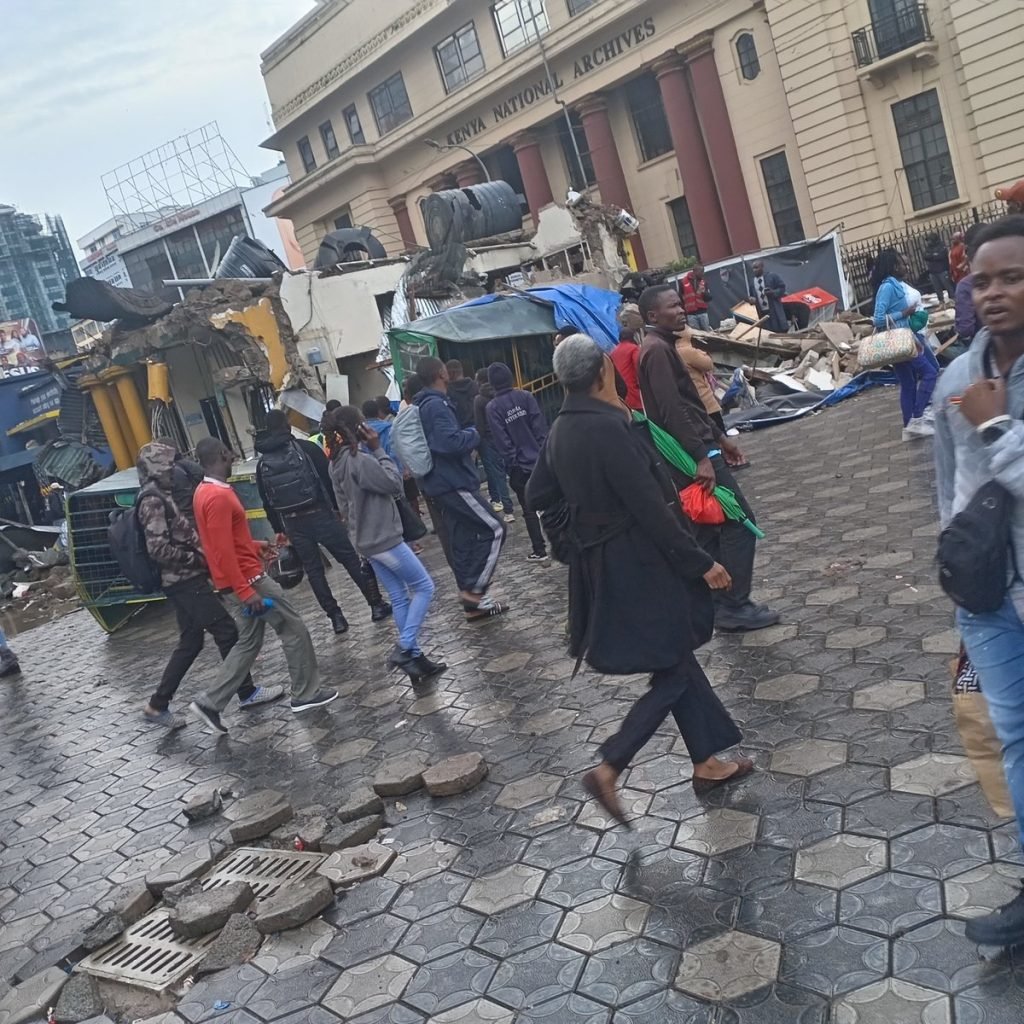
Floods, chaos, and collapsed systems haven’t just damaged the city. They have handed it over to criminals.
Nairobi is not just flooding. It is failing. And in the spaces where the State has retreated — the dark underpasses, the unlit estates, the waterlogged slums, the collapsed infrastructure — crime has moved in and made itself comfortable.
The two crises are not separate. They are the same crisis wearing different faces.
When systems collapse, so does safety
On the night of March 26 this year, the heavens opened over Nairobi. Wilson Airport recorded 160mm of rainfall. Moi Air Base recorded 145mm. In three to five hours, the city absorbed over 534mm of water — and buckled completely.
Thirty people died. Vehicles submerged. Power lines collapsed. Flights were cancelled. The government deployed the Kenya Defence Forces just to rescue stranded residents from their own streets.
But when the waters receded, something else remained: darkness, displacement, and desperation — the precise conditions under which crime thrives.
Floods
Approximately 60 percent of Nairobi’s residents live in informal settlements, many in flood-prone areas along river banks in Kibera, Mukuru, and Dandora.
When floods destroy homes and livelihoods, they don’t just create victims. They create vulnerability — and vulnerability is the raw material of criminal enterprise.
Infrastructure failure is a security failure
Nairobi’s drainage systems were designed to handle runoff from roads, not from buildings. Unscrupulous developers have spent decades filling entire plots with structures, eliminating the natural absorption capacity that once slowed floodwaters.
The result is a city where streets turn into rivers after less than an hour of rain.
But the same planning rot that broke the drainage also broke the lighting grids, the road networks, and the sewer systems that make neighbourhoods liveable and legible to law enforcement.
Areas like Kilimani, Kileleshwa, and South C — once middle-class anchors — are, in the words of architect Emma Miloyo, “slowly turning to urban slums.”
Where urban decay accelerates, policing becomes harder. Patrol routes become impassable. Emergency response times lengthen. Communities turn inward, relying on self-help — and sometimes on criminal proxies — for protection.
The 1927 plan, the 2026 reality
Nairobi’s master plans — the 1927 and 1948 frameworks — were designed by a colonial government to confine Africans to adverse conditions. The city has never fully escaped that founding logic.
The 1973 Metropolitan Growth Strategy expired in 2000 without full implementation. Planning has remained demand-driven rather than infrastructure-driven ever since.
The consequence is a capital city, as President Ruto himself acknowledged before the Nairobi County Assembly, where “flooding still kills our people, garbage defines neighbourhoods, roads are congested, drainage is broken, sewerage is overstretched, and basic order is too often absent.”
A city without order is a city that belongs to whoever imposes their own.
Urgent reform
Nairobi cannot be policed into safety while its infrastructure remains a crime enabler. The fixes are inseparable:
• Emergency lighting in flood-damaged and low-income areas must be treated as a security intervention, not just a utility upgrade.
• Drainage expansion must be funded partly through developer levies — those who profit from Nairobi’s roads must contribute to the systems that keep those roads functional and safe.
• Building enforcement must reach neighbourhood level, with plot ratios enforced and wetland encroachment prosecuted.
• A binding, fully funded master plan must replace the cycle of expired strategies and grand presidential declarations.
The criminals did not create Nairobi’s problems. They simply exploited the vacuum that bad governance left behind.
Nairobi is a city of extraordinary potential. It is also a city being steadily surrendered — not to enemies from outside, but to the neglect within. The time to fix it is not after the next flood. The time was yesterday.