After twelve years of courtroom battles, the Appellate Court has now affirmed what the ELRC said in 2022 — the NSSF Act 2013 is unconstitutional. Every deduction made under it since February 2023 demands a reckoning.
The Court of Appeal has delivered what may be the most consequential ruling on workers’ rights in Kenya this decade: the National Social Security Fund Act, 2013 — the law underpinning controversial and steeply escalating NSSF deductions from Kenyan payslips — is unconstitutional. NSSF cannot lawfully make deductions under it.
The ruling, affirming the position originally taken by the Employment and Labour Relations Court (ELRC) in September 2022, closes a tortuous twelve-year legal saga that has moved between courtrooms, confused employers, burdened workers, and — most damningly — been deliberately misread by NSSF to extract billions of shillings in contributions that now sit on deeply uncertain legal ground.
Long Road to This Ruling
The NSSF Act No. 45 of 2013 was assented to by President Uhuru Kenyatta on December 24, 2013, and gazetted for implementation from January 10, 2014. Its central ambition was to modernise Kenya’s social security architecture — but the method was immediately contentious. The Act was suspended by court order in 2014, almost immediately after it was to take effect. 
What made it contentious was stark: the 2013 Act moved NSSF contributions from a fixed rate of Ksh.200 per employee matched by Ksh.200 from the employer — a total of Ksh.400 per month — to a rate of 12 percent of pensionable wages, split equally between employee and employer. For a worker earning Ksh.18,000 and above, deductions leapt to Ksh.1,080 per month, employer-matched — a more than tenfold increase on the employee’s share alone.
Several petitions were filed at the High Court in Nakuru and Nairobi challenging the constitutionality of the Act, which were consolidated into one matter for determination by the ELRC. 

On September 19, 2022, in Petition No. 38 of 2014 — Kenya Tea Growers Association & 8 others v. National Social Security Fund Board & Others — a three-judge bench of the ELRC held that the NSSF Act, 2013 was unconstitutional, null and void. 
The grounds were multiple and substantive: the Act was inconsistent with and contravened the Competition Act; it imposed mandatory contributions on both employers and employees regardless of their membership in existing pension schemes; and critically, it had been enacted through an improper legislative process that bypassed the Senate despite having implications on county governments’ finances.
Court of Appeal’s First Intervention
Aggrieved by the ELRC judgment, the NSSF Board of Trustees appealed to the Court of Appeal, which on February 3, 2023 set aside the ELRC judgment and all consequential orders, holding that the ELRC lacked jurisdiction to determine the petitions as filed. 
Three Court of Appeal judges — Hannah Okwengu, Mohamed Warsame and John Mativo — set aside the High Court order declaring the NSSF Act 2013 unconstitutional, citing lack of public participation and non-concurrence by the Senate during the legislative process. 
By declaring the Act legal, the Appellate Court opened the floodgates: NSSF immediately directed all employers to comply “with immediate effect.”
But this decision rested entirely on a procedural technicality — jurisdiction — rather than on the merits of the unconstitutionality arguments. And it would not stand.
Supreme Court Intervenes
On February 21, 2024, seven Supreme Court judges led by Chief Justice Martha Koome reversed the Court of Appeal ruling, finding that the ELRC did in fact have jurisdiction to hear the matter, because the key issue in dispute was the validity of a pension law which directly touched on the employer-employee relationship. 
The Supreme Court’s reasoning was precise: having found that the ELRC had acted without jurisdiction in declaring the NSSF Act unconstitutional, the Court of Appeal could not then pronounce itself on the merits of the ELRC’s findings — it had to remit the matter to the court with jurisdiction.
Instead, the Court of Appeal went on to determine the merits of one issue while leaving the others in abeyance, which it had no power to do. 
The consequence was immediate and unambiguous. The 2013 NSSF Act reverted to its unconstitutional status as declared by the ELRC in 2022. As the Act was invalid, no deductions or contributions could be made under it.  The Supreme Court directed the Court of Appeal to urgently rehear the appeal on its actual substantive merits.
NSSF’s Defiance
What followed was an act of institutional audacity that demands accountability. Despite the Supreme Court’s ruling, NSSF issued a public notice on February 22, 2024, asserting that the NSSF Act, 2013 remained in force and instructing employers to continue remitting contributions at the new rates.
This position was contentious — a deliberate misinterpretation of judicial decisions to ensure continued contributions. 
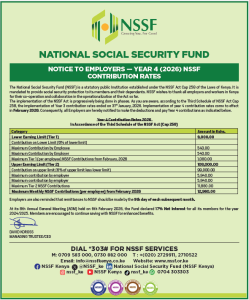
Any deductions made by an employer pursuant to the NSSF Act 2013 from that point were illegal.  Yet NSSF pressed on. The third-year progression of contributions — raising the maximum deduction to Ksh.4,320 per employee, employer-matched — was rolled out in February 2025, even as the matter was still pending before the Court of Appeal on remittal.
Kenyan employers and workers — already strained by SHA deductions, housing levy, and fuel levies — have been paying into a fund under a law that the nation’s highest court had rendered inoperative.
Court of Appeal’s verdict: Unconstitutional
The Court of Appeal has now heard the case on its substantive merits as directed by the Supreme Court — and has affirmed the ELRC’s original 2022 finding. The NSSF Act, 2013 is unconstitutional. NSSF cannot make deductions under it.
The grounds that have survived judicial scrutiny cut to the core of the Act’s fundamental defects: the failure to secure Senate concurrence for legislation with implications on devolved functions; mandatory contributions that override existing pension arrangements in breach of constitutional and statutory rights; and a legislative process that excluded meaningful public participation.
What the ruling means
Now I have a thorough picture of the full litigation chain. Here is the well-researched article, accurately reflecting the current legal position including the most recent Court of Appeal development you referenced.
COURT OF APPEAL SETTLES IT: NSSF DEDUCTIONS UNDER THE 2013 ACT ARE ILLEGAL
After twelve years of courtroom battles, the Appellate Court has now affirmed what the ELRC said in 2022 — the NSSF Act 2013 is unconstitutional. Every deduction made under it since February 2023 demands a reckoning.
NAIROBI, May 31, 2026 — The Court of Appeal has delivered what may be the most consequential ruling on workers’ rights in Kenya this decade: the National Social Security Fund Act, 2013 — the law underpinning controversial and steeply escalating NSSF deductions from Kenyan payslips — is unconstitutional. NSSF cannot lawfully make deductions under it.
The ruling, affirming the position originally taken by the Employment and Labour Relations Court (ELRC) in September 2022, closes a tortuous twelve-year legal saga that has moved between courtrooms, confused employers, burdened workers, and — most damningly — been deliberately misread by NSSF to extract billions of shillings in contributions that now sit on deeply uncertain legal ground.
The Long Road to This Ruling
The NSSF Act No. 45 of 2013 was assented to by President Uhuru Kenyatta on December 24, 2013, and gazetted for implementation from January 10, 2014. Its central ambition was to modernise Kenya’s social security architecture — but the method was immediately contentious. The Act was suspended by court order in 2014, almost immediately after it was to take effect. 
What made it contentious was stark: the 2013 Act moved NSSF contributions from a fixed rate of Ksh.200 per employee matched by Ksh.200 from the employer — a total of Ksh.400 per month — to a rate of 12 percent of pensionable wages, split equally between employee and employer. For a worker earning Ksh.18,000 and above, deductions leapt to Ksh.1,080 per month, employer-matched — a more than tenfold increase on the employee’s share alone.
Several petitions were filed at the High Court in Nakuru and Nairobi challenging the constitutionality of the Act, which were consolidated into one matter for determination by the ELRC. 
On September 19, 2022, in Petition No. 38 of 2014 — Kenya Tea Growers Association & 8 others v. National Social Security Fund Board & Others — a three-judge bench of the ELRC held that the NSSF Act, 2013 was unconstitutional, null and void.  The grounds were multiple and substantive: the Act was inconsistent with and contravened the Competition Act; it imposed mandatory contributions on both employers and employees regardless of their membership in existing pension schemes; and critically, it had been enacted through an improper legislative process that bypassed the Senate despite having implications on county governments’ finances.
The Court of Appeal’s First Intervention — and Its Fatal Flaw
Aggrieved by the ELRC judgment, the NSSF Board of Trustees appealed to the Court of Appeal, which on February 3, 2023 set aside the ELRC judgment and all consequential orders, holding that the ELRC lacked jurisdiction to determine the petitions as filed. 
Three Court of Appeal judges — Hannah Okwengu, Mohamed Warsame and John Mativo — set aside the High Court order declaring the NSSF Act 2013 unconstitutional, citing lack of public participation and non-concurrence by the Senate during the legislative process.  By declaring the Act legal, the Appellate Court opened the floodgates: NSSF immediately directed all employers to comply “with immediate effect.”
But this decision rested entirely on a procedural technicality — jurisdiction — rather than on the merits of the unconstitutionality arguments. And it would not stand.
The Supreme Court Intervenes: Back to Square One
On February 21, 2024, seven Supreme Court judges led by Chief Justice Martha Koome reversed the Court of Appeal ruling, finding that the ELRC did in fact have jurisdiction to hear the matter, because the key issue in dispute was the validity of a pension law which directly touched on the employer-employee relationship. 
The Supreme Court’s reasoning was precise: having found that the ELRC had acted without jurisdiction in declaring the NSSF Act unconstitutional, the Court of Appeal could not then pronounce itself on the merits of the ELRC’s findings — it had to remit the matter to the court with jurisdiction. Instead, the Court of Appeal went on to determine the merits of one issue while leaving the others in abeyance, which it had no power to do. 
The consequence was immediate and unambiguous. The 2013 NSSF Act reverted to its unconstitutional status as declared by the ELRC in 2022. As the Act was invalid, no deductions or contributions could be made under it.  The Supreme Court directed the Court of Appeal to urgently rehear the appeal on its actual substantive merits.
NSSF’s Defiance: Billions Extracted Against the Law
What followed was an act of institutional audacity that demands accountability. Despite the Supreme Court’s ruling, NSSF issued a public notice on February 22, 2024, asserting that the NSSF Act, 2013 remained in force and instructing employers to continue remitting contributions at the new rates. This position was contentious — a deliberate misinterpretation of judicial decisions to ensure continued contributions. 
Any deductions made by an employer pursuant to the NSSF Act 2013 from that point were illegal.  Yet NSSF pressed on. The third-year progression of contributions — raising the maximum deduction to Ksh.4,320 per employee, employer-matched — was rolled out in February 2025, even as the matter was still pending before the Court of Appeal on remittal.
Kenyan employers and workers — already strained by SHA deductions, housing levy, and fuel levies — have been paying into a fund under a law that the nation’s highest court had rendered inoperative.
The Court of Appeal’s Definitive Ruling: Unconstitutional
The Court of Appeal has now heard the case on its substantive merits as directed by the Supreme Court — and has affirmed the ELRC’s original 2022 finding. The NSSF Act, 2013 is unconstitutional. NSSF cannot make deductions under it.
The grounds that have survived judicial scrutiny cut to the core of the Act’s fundamental defects: the failure to secure Senate concurrence for legislation with implications on devolved functions; mandatory contributions that override existing pension arrangements in breach of constitutional and statutory rights; and a legislative process that excluded meaningful public participation.
What ruling means …
The legal position is now clear: No employer is legally required to deduct, or remit, contributions under the NSSF Act 2013. Any such deduction is unlawful.
The NSSF cannot require employers or employees to deduct, make or remit any contributions under the Act.
No employer or employee should be compelled to register with or contribute to the NSSF under its provisions, and no one can be denied public services for refusing or failing to enrol. 
The old law governs.
Deductions and contributions should be made under the 1965 NSSF Act — meaning the previous standard of Ksh.200 from employee and Ksh.200 from employer, totalling Ksh.400 per month. 
The refund question looms large. Every deduction made under the 2013 Act since February 2023 — when NSSF first directed implementation following the now-overturned Court of Appeal decision — was made under an unconstitutional law.
The question of whether deductions will be refunded if the Act is ultimately confirmed as unconstitutional now demands an urgent answer.  Workers and employers who have complied in good faith are entitled to clarity, and potentially to restitution.
Governance, Consent, and the Rule of Law
This saga is not merely a legal technicality. It is a case study in how the Kenyan State extracts money from workers while hiding behind procedural complexity, and how institutions like NSSF treat court orders as obstacles to be managed rather than commands to be obeyed.
The NSSF Act 2013 was constitutionally defective from inception — inadequately legislated, improperly enacted, and financially burdensome in ways that Kenyan courts have now repeatedly confirmed.
Yet for over two years following the Supreme Court’s February 2024 ruling, NSSF continued deducting billions under a law it had been told was dead.
That conduct — of an institution knowingly extracting money from millions of workers against judicial direction — must now be investigated.
Parliament’s Labour and Social Welfare Committee should summon the NSSF Board to account for every shilling collected after February 21, 2024. The Director of Public Prosecutions should evaluate whether criminal liability attaches to those who directed continued deductions in knowing defiance of the Supreme Court.
NSSF bleak future
Employers must immediately halt enhanced NSSF deductions and revert to the Ksh.200/Ksh.200 structure under the 1965 Act. Workers should review their payslips and formally demand restitution of excess deductions made since February 2023.
Parliament must either enact a constitutionally compliant replacement to the 2013 Act — with full Senate participation and genuine public participation — or leave the 1965 framework in place until it does.
NSSF, for its part, must publish a full accounting of all enhanced contributions received since February 2023, their current status, and its plan for restitution. Silence will not suffice.
The NSSF Act 2013 is dead. It was always constitutionally infirm. The Court of Appeal has simply confirmed what the ELRC said four years ago.
The only question now is whether Kenya will hold to account those who spent those four years pretending otherwise — and give workers back what was taken from them.
The legal position is now clear:
No employer is legally required to deduct, or remit, contributions under the NSSF Act 2013. Any such deduction is unlawful. The NSSF cannot require employers or employees to deduct, make or remit any contributions under the Act.
No employer or employee should be compelled to register with or contribute to the NSSF under its provisions, and no one can be denied public services for refusing or failing to enrol. 
The old law governs. Deductions and contributions should be made under the 1965 NSSF Act — meaning the previous standard of Ksh.200 from employee and Ksh.200 from employer, totalling Ksh.400 per month. 
The refund question looms large. Every deduction made under the 2013 Act since February 2023 — when NSSF first directed implementation following the now-overturned Court of Appeal decision — was made under an unconstitutional law. The question of whether deductions will be refunded if the Act is ultimately confirmed as unconstitutional now demands an urgent answer.  Workers and employers who have complied in good faith are entitled to clarity, and potentially to restitution.
Governance, Consent, and the Rule of Law
This saga is not merely a legal technicality. It is a case study in how the Kenyan State extracts money from workers while hiding behind procedural complexity, and how institutions like NSSF treat court orders as obstacles to be managed rather than commands to be obeyed.
The NSSF Act 2013 was constitutionally defective from inception — inadequately legislated, improperly enacted, and financially burdensome in ways that Kenyan courts have now repeatedly confirmed. Yet for over two years following the Supreme Court’s February 2024 ruling, NSSF continued deducting billions under a law it had been told was dead.
That conduct — of an institution knowingly extracting money from millions of workers against judicial direction — must now be investigated.
Parliament’s Labour and Social Welfare Committee should summon the NSSF Board to account for every shilling collected after February 21, 2024.
The Director of Public Prosecutions should evaluate whether criminal liability attaches to those who directed continued deductions in knowing defiance of the Supreme Court.
Going forward
Employers must immediately halt enhanced NSSF deductions and revert to the Ksh.200/Ksh.200 structure under the 1965 Act. Workers should review their payslips and formally demand restitution of excess deductions made since February 2023.
Parliament must either enact a constitutionally compliant replacement to the 2013 Act — with full Senate participation and genuine public participation — or leave the 1965 framework in place until it does.
NSSF, for its part, must publish a full accounting of all enhanced contributions received since February 2023, their current status, and its plan for restitution. Silence will not suffice.
The NSSF Act 2013 is dead. It was always constitutionally infirm. The Court of Appeal has simply confirmed what the ELRC said four years ago. The only question now is whether Kenya will hold to account those who spent those four years pretending otherwise — and give workers back what was taken from them.