The National Social Security Fund has issued what it calls a Public Statement: Clarification on the Status of NSSF Contributions.
COFEK has subjected it to legal scrutiny. The verdict is unambiguous: it clarifies nothing — and in fact deepens the confusion it purports to resolve.
The Fund makes three key claims. First, that the NSSF Act 2013 is “still in force” on account of the Court of Appeal judgment of 3rd February 2023.
Second, that issues pending determination “do not in any way affect contribution rates.”
Third, that contributions remain at the “year four (4) cycle in accordance with the Third Schedule.” Each of these claims is either misleading, legally imprecise, or outright contradicted by the court record.
Court of Appeal Did Not Validate Higher Contribution Rates
The most fundamental error in NSSF’s statement is the conflation of two entirely separate legal questions: whether the NSSF Act 2013 is constitutional, and whether the enhanced contribution rates are enforceable.
These are not the same question, and answering the first does not resolve the second.
The Court of Appeal on 3rd February 2023 found the Act constitutional in principle. However, it critically struck down or remitted back provisions touching on the contribution framework — specifically on account of the lack of adequate public participation in setting rates.
The Act surviving in skeleton form does not mean the Third Schedule rates survived with it. NSSF is using the Act’s partial survival as a Trojan horse to smuggle in rates that were never cleared by the courts. That is not legal interpretation — it is legal sleight of hand.
“Year Four Cycle” Rates Were Never Legitimately Triggered
The Third Schedule of the NSSF Act operates on a phased implementation model. Year 4 rates presuppose that Years 1 through 3 were lawfully implemented.
They were not. Courts intervened at the very threshold of the scheme’s implementation, before it could lawfully commence.
You cannot be in Year 4 of a scheme that never legally commenced Year 1.
This is elementary statutory construction. A condition precedent that was never satisfied cannot simply be leapfrogged by administrative declaration.
NSSF’s assertion that Year 4 rates currently apply has no defensible legal foundation given the history of judicial intervention in this matter.
Statement Directly Contradicts Itself
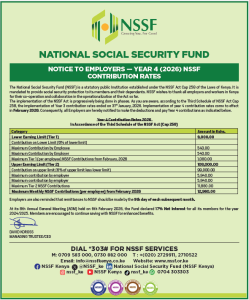
Perhaps the most damaging feature of NSSF’s statement is its internal contradiction, which no careful reader can miss. The Fund states in one breath that “the issues pending determination by the Court do not in any way affect contribution rates,” and then in the very next passage calls on stakeholders to “allow the Court of Appeal to give directions on the issues that are still pending determination and which do not affect the enhanced contribution rates.”
The contradiction is glaring. If the pending issues truly do not affect contribution rates, there is no reason whatsoever for NSSF to ask employers to hold firm pending the Court’s directions.
The Fund is simultaneously arguing that the rates are legally settled and conceding that it is waiting for the court to say so. It cannot have it both ways. A statement that contradicts itself within the space of two paragraphs is not a clarification — it is an admission dressed in confident language.
“Disregard Misleading Opinions” Is Regulatory Intimidation
One of the most extraordinary passages in NSSF’s statement is its instruction to employers, employees and stakeholders to “disregard the misleading opinions alluding to reverting contributions to Ksh.200.”
For a statutory body to publicly direct citizens to disregard legal opinions on a live constitutional matter is remarkable and deeply troubling.
The opinions NSSF dismisses as misleading are grounded in the rulings of the Employment and Labour Relations Court, the Court of Appeal’s own qualified endorsement of limited provisions, and the constitutional public participation doctrine enshrined in Article 10 and Article 118 of the Constitution of Kenya 2010.
These are not fringe views. They are positions with direct judicial support. Labelling court-grounded legal analysis as “misleading opinions” is not clarification — it is regulatory intimidation, and it undermines the public’s legitimate right to seek and rely on independent legal counsel.
The Sh.715 Billion Fund Size Is Irrelevant to Legal Compliance
NSSF’s statement devotes considerable space to its financial achievements — a fund size of Ksh.715 billion and a declared net return of 17% for the 2024/2025 financial year.
These figures are offered as if impressive financial performance cures a constitutional defect in the legal basis for collecting contributions. It does not, and the two things have no legal relationship whatsoever.
The question before the courts was never whether NSSF is well-managed or generating good returns.
The question is whether the legal basis for collecting enhanced contributions was validly established in accordance with the Constitution, including the requirement for public participation.
No return-on-investment figure, however impressive, answers that constitutional question.
Deploying fund growth statistics in a legal clarification is a classic non sequitur — emotionally persuasive to the uninformed, but legally worthless.
Employers Are Being Exposed to Unlawful Deductions
By directing employers to continue deducting and remitting at enhanced rates pending court directions, NSSF is asking employers to assume a legal risk that is properly the Fund’s own.
This is deeply unfair and potentially unlawful in itself.
If the Court of Appeal ultimately rules that the enhanced rates were never validly established, employers who deducted and remitted at those rates will face serious consequences.
Employees may bring claims for unlawful wage deductions under the Employment Act 2007. Employers may face potential liability for unjust enrichment in respect of funds passed to NSSF on an invalid basis.
They may also face regulatory exposure for having acted on ultra vires administrative directions. NSSF cannot outsource its legal uncertainty to employers and workers. The risk belongs to the institution that created the uncertainty — not to those it regulates.
Why Is NSSF Issuing Legal Opinions Without the Attorney General?
COFEK poses a pointed and fundamental question: why is NSSF offering its own self-serving legal interpretation of a live court matter without first seeking a formal advisory opinion from the Attorney General’s office?
The Attorney General is the Government’s principal legal adviser under Article 156 of the Constitution of Kenya 2010. Where there is genuine legal uncertainty — as NSSF itself tacitly concedes by awaiting Court of Appeal directions — the proper and constitutionally appropriate course is a formal AG advisory opinion, not a press release dressed up as a legal clarification.
The fact that NSSF bypassed the Attorney General and spoke directly to employers and workers through a public statement suggests that this document is communications strategy, not legal guidance. It is designed to maintain contribution flows, not to honestly inform the public of the legal position.
COFEK’s Position
The honest clarification NSSF should have issued would read as follows:
“The legal status of enhanced contribution rates remains sub judice. Pending the Court of Appeal’s definitive directions, we advise all stakeholders to seek independent legal counsel and to await judicial determination before adjusting their deduction practices.”
That NSSF did not say this — and instead directed the public to disregard court-grounded legal opinions — tells you everything about the intent behind this statement. It is not a clarification. It is a pressure campaign.
COFEK reiterates its considered position: enhanced NSSF contributions lack a confirmed legal foundation pending conclusive judicial determination. Workers and employers have a constitutional right to clarity from the courts — not confusion, intimidation, and misdirection from the Fund itself.
For further information contact COFEK Secretariat | cofek.africa. The Consumers Federation of Kenya (COFEK) is Kenya’s principal statutory consumer advocacy body established under the Consumer Protection Act.