


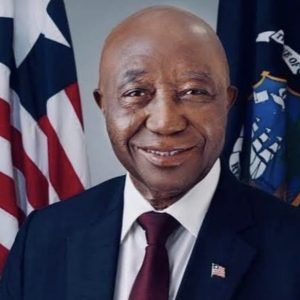
Liberia, one of the poorest nations in Africa, has agreed to accept up to 1,200 third-country deportees from the United States over the coming year, marking one of the largest such arrangements struck under President Donald Trump’s sweeping immigration crackdown.
Liberian authorities confirmed the agreement this week, with Information Minister Jerolinmek Piah telling reporters that the first batch of 20 deportees is expected to arrive within days.
The full complement of 1,200 will include not only Africans but also nationals from North America, South America and the Caribbean — underscoring that the arrangement is not a repatriation programme for Liberian citizens but a “third-country” resettlement scheme for people with no ties to the country.
Liberia’s Justice Minister, Natu Oswald Tweh, said the government has already screened the incoming list, noting that most of those due to arrive have immigration violations rather than serious criminal records.
Officials say deportees will be free to apply for asylum in Liberia or to leave the country at will, and that Washington will provide support to help Monrovia manage the programme and strengthen its migration infrastructure.
Piah described the move as “entirely humanitarian,” in line with Liberia’s history as a nation founded by freed and formerly enslaved Black Americans in the 19th century.
Critics, however, note that the deal is part of a much broader — and largely undisclosed — pattern.
Under a series of agreements that have often been struck in secret, the Trump administration has transferred thousands of migrants to nearly two dozen countries worldwide that are not their countries of origin, roughly ten of them in Africa.
Immigration lawyers argue the practice functions as a legal workaround, allowing Washington to indirectly return asylum seekers to danger by routing them through third states rather than the countries from which they originally fled — including some individuals who hold formal US protection orders barring their removal to their home countries.
Abrego Garcia Backdrop
The Liberia announcement lands amid the Trump administration’s continuing, high-profile effort to deport Kilmar Abrego Garcia, the Salvadoran man whose case became a national flashpoint after he was mistakenly deported to El Salvador’s notorious CECOT mega-prison in March 2025, in defiance of a standing US immigration order.
Abrego Garcia was eventually returned to the United States following Supreme Court intervention, only to face federal human-smuggling charges — later dismissed by a judge who called the prosecution “vindictive and selective.”
Since then, the administration has repeatedly sought to remove Abrego Garcia to a rotating list of African nations — first Uganda, then Eswatini, and, most notably, Liberia — despite his stated preference to be sent to Costa Rica, which has offered him a path to legal status.
A federal judge has already blocked several of these attempts, at one point ruling that the government had made “one empty threat after another” to deport him to Africa “with no real chance of success.”
Critics, including Abrego Garcia’s own legal team, argue that targeting him specifically for removal to Africa — a continent with which he has no connection — reflects a punitive motive rather than routine immigration enforcement.
Tariffs, Visas and Leverage
The Liberia arrangement fits a wider diplomatic pattern documented by The New York Times and other outlets:
Washington has offered to ease tariffs, lift visa restrictions or restore consular privileges for governments willing to accept deportees, while threatening the same countries with economic and travel penalties if they refuse.
The Times has reported that the administration pressed dozens of countries, many in Africa, as part of what it called an “intense diplomatic campaign” tied to the threat of US travel bans and tariffs.
Ghana offers the clearest precedent
After Accra began accepting West African deportees earlier this year, Washington reversed visa restrictions on Ghanaian nationals and lifted a 15% tariff on the country’s cocoa and agricultural exports — even as Ghanaian officials insisted they had received nothing in direct exchange.
Rwanda, Eswatini, South Sudan, Sierra Leone and the Central African Republic have all entered similar, largely opaque arrangements.
Not every country has benefited: Equatorial Guinea, for instance, struck a deportation deal but remains subject to a US travel ban, according to reporting. Analysts at the Institute for Security Studies say the leverage extends beyond trade — with aid, security cooperation and diplomatic goodwill all used as bargaining chips, often with African governments facing steep costs for non-compliance and comparatively thin rewards for cooperation.
Not every nation has complied. Nigeria and Burkina Faso have publicly rejected US pressure to accept deportees, with Nigerian officials calling the visa and tariff threats “not reciprocal but a pressure tactic,” and Burkina Faso’s foreign minister labelling a related US visa suspension “blackmail.”
Deterrence at Home
The deportation push — and the third-country strategy in particular — is central to the administration’s broader immigration narrative.
US Customs and Border Protection has reported more than a year of consecutive months with “zero releases” of migrants at the southern border, and illegal crossings have fallen to levels not recorded in decades, a trend officials attribute directly to aggressive enforcement and removal policies, including the threat of deportation to unfamiliar, distant countries as a deterrent against future unauthorised entry.
The Stakes for Liberia
For Liberia — a country still rebuilding from back-to-back civil wars and the 2014 Ebola crisis, and ranked among the world’s poorest by per-capita income — the arrangement carries both opportunity and risk.
Washington’s offer of migration-management support and improved bilateral standing could yield tangible economic dividends, echoing the tariff and visa concessions seen elsewhere.
But rights groups warn that under-resourced host states risk becoming dumping grounds for people with no local ties, language, or support networks, with reintegration and protection obligations that Monrovia has yet to detail publicly.
How Liberia manages the arrival of the first deportees this week — and whether Washington’s promised support materialises — is likely to shape both its migration relationship with the US and the terms other African governments extract from future deals.