How a UK "car exporter" took a Kenyan consumer's Sh2.3 million and left a dream car undelivered
The model is not new. Fraudulent "exporters" advertise attractive cars online, use professional-looking invoices and websites, and ask for payment into foreign accounts that are difficult to trace.
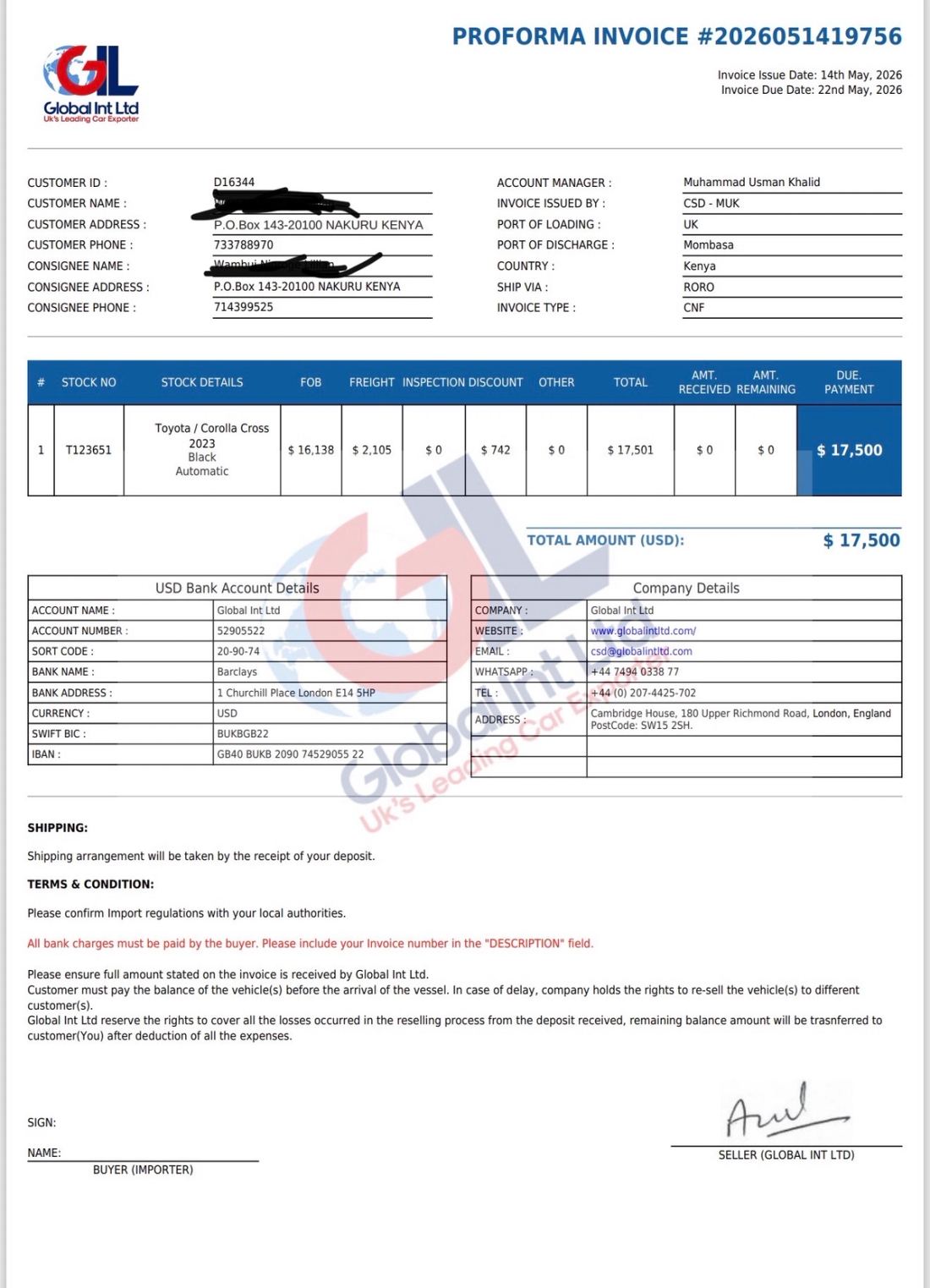
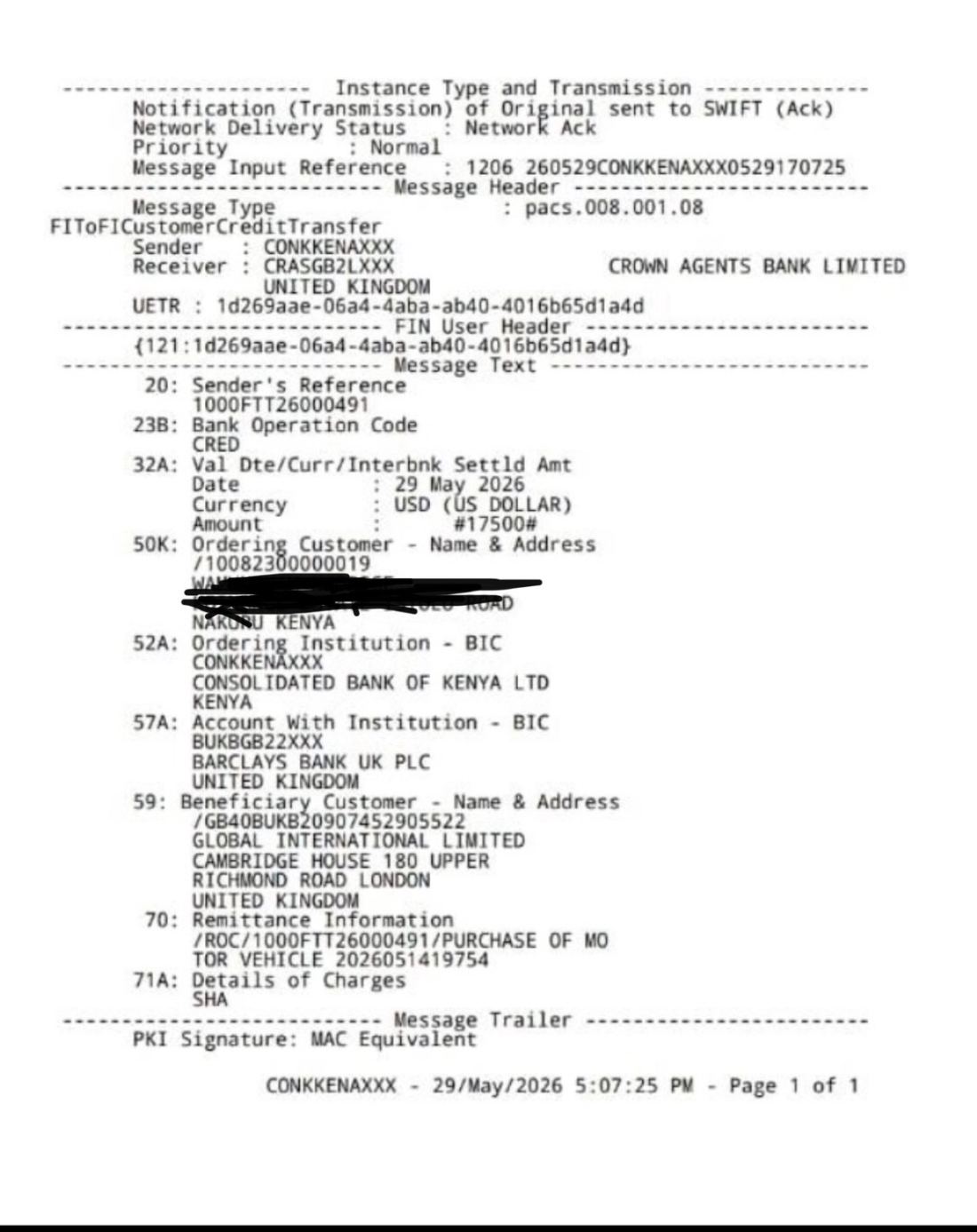
A glossy invoice, a London address and a SWIFT transfer. Documents reviewed show how a car import deal ended as an alleged scam.
For W.N., a Nakuru resident, the offer looked like a smart way to beat Nairobi's high car prices: a 2023 Toyota Corolla Cross, black, automatic, shipped from the UK to Mombasa for a little over Sh2 million. Today, the money is gone and the car has not arrived.
The offer
On 14 May 2026, Global Int Ltd, which brands itself "UK's Leading Car Exporter", issued W.N. a proforma invoice, No. 2026051419756.
It named the buyer and consignee with a Nakuru P.O. Box address and listed the vehicle under stock number T123651.
The pricing was precise, which lent credibility. The invoice showed an FOB price of $16,138, freight of $2,105 and a discount of $742, bringing the total to $17,500. It was a CNF (cost and freight) deal, shipped by RORO from the UK to Mombasa.
The invoice carried a company logo, a watermark, a named account manager, a website, a UK phone number and a London address. It also bore a signature on the seller's side, while the buyer's signature block was blank.
The terms were typical of such schemes. Shipping would be arranged "by the receipt of your deposit". The buyer was told to confirm import regulations with local authorities, pay all bank charges, and settle the full balance before the vessel arrived. If the buyer delayed, the company reserved the right to resell the car.
The payment
On 29 May 2026, W.N. instructed Consolidated Bank of Kenya to send $17,500 to the account on the invoice.
A SWIFT payment confirmation (pacs.008) shows the transfer routed through Crown Agents Bank in the UK to Barclays Bank UK PLC, for credit to the beneficiary, Global International Limited.
The remittance field read "Purchase of motor vehicle". At prevailing rates, the amount was about Sh2.3 million.
The bank's record shows the instruction was processed. It does not show that the car was ever bought, inspected, shipped or tied to W.N.'s name.
The red flags
Read carefully, the documents contain warning signs a prudent buyer should heed:
- Mismatched references. The invoice number is 2026051419756, but the payment reference quotes 2026051419754. The payment details do not cleanly match the invoice they were meant to settle.
- Mismatched names. The beneficiary in the transfer is "Global International Limited", while the invoice is issued by "Global Int Ltd". The buyer's name also appears differently across the invoice and the bank record.
- A payment account at a retail bank. The beneficiary's account is a Barclays account in the company's name, with the bank's address on the invoice shown as a Churchill Place location. A bank's address on an invoice says nothing about the account holder's legitimacy.
- Late payment, no questions. The invoice fell due on 22 May. The money moved a week later, with no apparent confirmation that the vehicle was still available.
- Pressure and one-sided terms. The company could resell the car and deduct "all the expenses" if the buyer delayed, while it assumed no clear obligation to produce a bill of lading, export certificate or vessel details.
- Full upfront payment. The invoice demanded the entire amount before shipping, with no escrow, no independent inspection and no verifiable proof of ownership.
Why this scheme works
The model is not new. Fraudulent "exporters" advertise attractive cars online, use professional-looking invoices and websites, and ask for payment into foreign accounts that are difficult to trace.
Buyers are told that everything will be shipped once a deposit lands. By the time delays begin, the funds have been moved on.
Kenyan buyers are especially exposed because the dollar cost of a used import is attractive, and because many believe a bank-to-bank transfer is inherently safe. It is not.
A SWIFT confirmation proves only that money left an account. It proves nothing about whether the seller is genuine.
What consumers can do
Anyone considering a vehicle import should:
- Verify the exporter independently, including company registration at Companies House in the UK, physical premises and track record with past Kenyan customers.
- Insist on the logbook or export documents, chassis number and inspection report before paying.
- Use an agent registered in Kenya, or pay through escrow or a letter of credit, rather than wiring the full amount to an unknown beneficiary.
- Cross-check every figure and name on the invoice against the payment instruction before sending.
- Check the vehicle details against the Kenya Revenue Authority and Kenya Bureau of Standards import requirements.
Where the money may be recovered
W.N. has options, though speed matters. The first step is to ask Consolidated Bank of Kenya to formally recall the payment and to notify the correspondent and beneficiary banks of suspected fraud.
Reports should also go to the Directorate of Criminal Investigations, the Banking Fraud Investigations Unit and UK authorities, including Action Fraud, so that the Barclays (Absa bank) account can be flagged and, if possible, frozen.
Regulators and consumer bodies should also be notified so that other buyers are warned.
Global Int Ltd had not responded to the allegations at the time of writing. Any response will be published.
The lesson is simple. A professional-looking invoice is not proof of a genuine seller. Before a single dollar leaves Kenya, a buyer must be able to prove that the car, and the company, exist.
Filed underOnline fraud, Barclays, Absa Bank, Vehicle, Import, COFEK