744,000 BMWs Recalled Over Fire Risk — And Why African Consumers Can’t Just Shrug It Off
The COMESA Competition and Consumer Commission (CCCC) has issued a public warning covering 744,234 BMW vehicles worldwide, after Germany’s Kraftfahrt-Bundesamt (KBA) flagged a fire hazard tied to the engine starter motor.
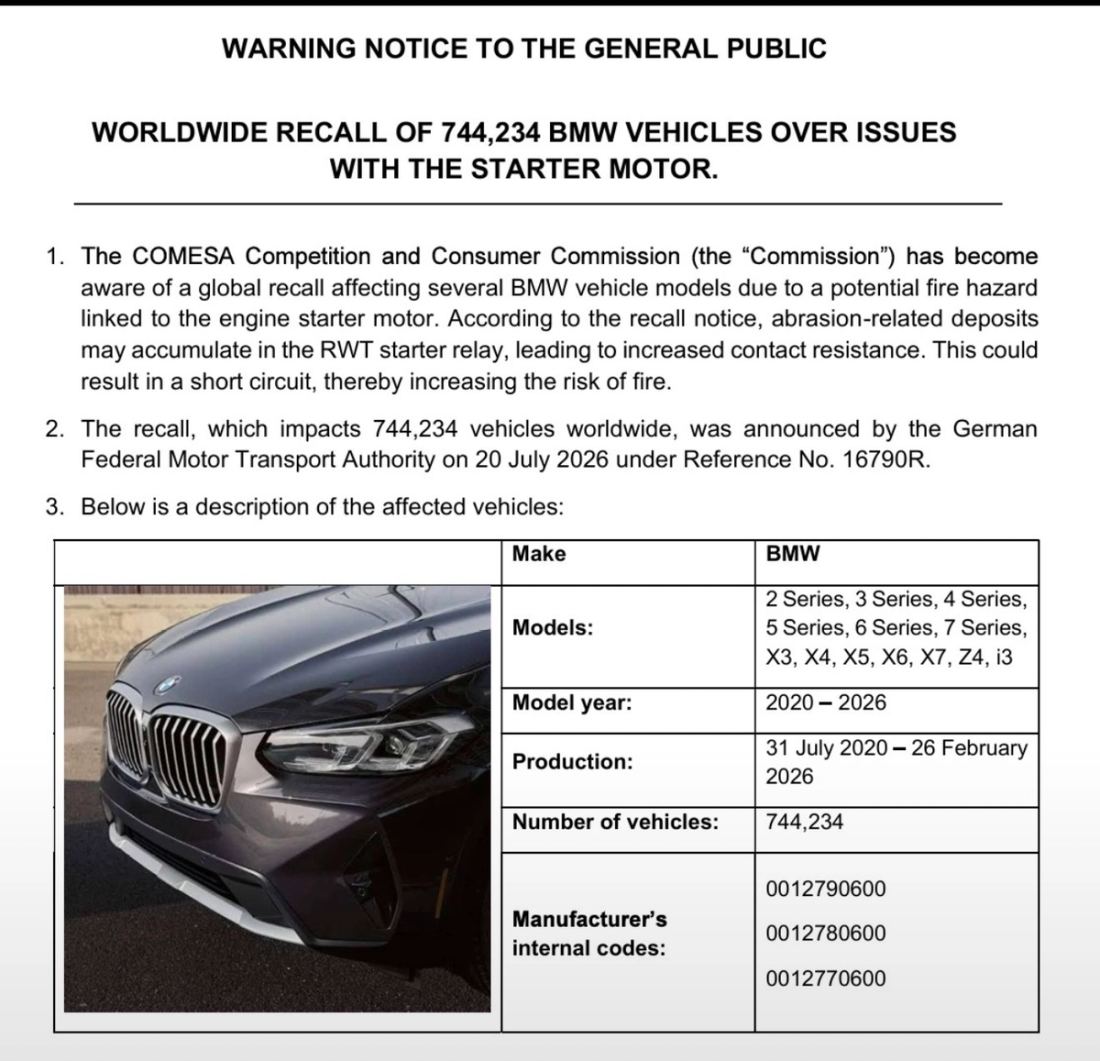
A global recall notice has just landed on the desks of regulators across the COMESA trade bloc, and it deserves more attention in this region than it is likely to get. The COMESA Competition and Consumer Commission (CCCC) has issued a public warning covering 744,234 BMW vehicles worldwide, after Germany’s Kraftfahrt-Bundesamt (KBA) flagged a fire hazard tied to the engine starter motor.
The defect: abrasion-related deposits building up inside the RWT starter relay, raising contact resistance to the point where a short circuit — and potentially a fire — becomes possible.
The KBA opened the case under reference 16790R on 20 July 2026, covering vehicles built between 31 July 2020 and 26 February 2026. The affected range is broad — the 2, 3, 4, 5, 6 and 7 Series, the X3, X4, X5, X6 and X7, the Z4 and the i3 — which is precisely why this matters here. These are not obscure trims; they are among the most commonly imported BMW models into East and Southern African markets, many arriving as used vehicles from Europe, Japan, the UK and the Gulf rather than through official BMW distributors.
The CCCC’s notice explicitly acknowledges this exposure, noting that COMESA member states “import the affected models from different parts of the world,” meaning recalled units may already be circulating locally without owners ever being told. That gap is the real story: A recall announced in Bonn does not automatically translate into a phone call, an SMS, or a dealership visit for an owner in Nairobi, Lusaka or Kampala. Manufacturer recall systems are generally built around the market of first sale, tracked by VIN through the original national registration authority.
Once a vehicle is re-exported into the grey or used-import market, that thread often breaks — leaving the safety obligation to fall on the consumer’s own initiative, or on institutions like the CCCC to plug the gap through public notices.
To their credit, the CCCC has done what a consumer protection body should: it has invoked Regulation 66 of the COMESA Competition and Consumer Protection Regulations, 2025, to issue a formal cross-border alert, and Regulation 59 to press BMW on completing the recall within the Common Market.
Owners are directed to check their 17-digit VIN through BMW’s own recall portal or Germany’s KBA database, and to have the starter motor replaced free of charge at an authorised workshop. The harder question is enforcement capacity. Regional bodies can issue notices; they cannot compel a manufacturer’s regional distributor network to proactively trace every re-exported unit, nor can they force compliance the way a well-resourced national consumer authority might.
For consumers, the practical takeaway is blunt: do not wait for a letter that may never arrive. If you own an affected BMW model built in this window, run your VIN through the checker yourself. This recall is also BMW’s third starter-related fire campaign inside twelve months — after a roughly 575,000-vehicle recall in February and a 145,000-vehicle campaign last year — a pattern regulators and consumer groups across import-dependent markets like Kenya’s would do well to keep watching, rather than treating each notice as an isolated European affair.