Aliko Dangote’s Lamu Refinery: A Sh2.2 Trillion Bet Kenyan Consumers Must Scrutinise
Government messaging has centred on jobs and energy security. Deputy President Kithure Kindiki has put the jobs figure at more than 50,000, with government projections reaching 60,000.
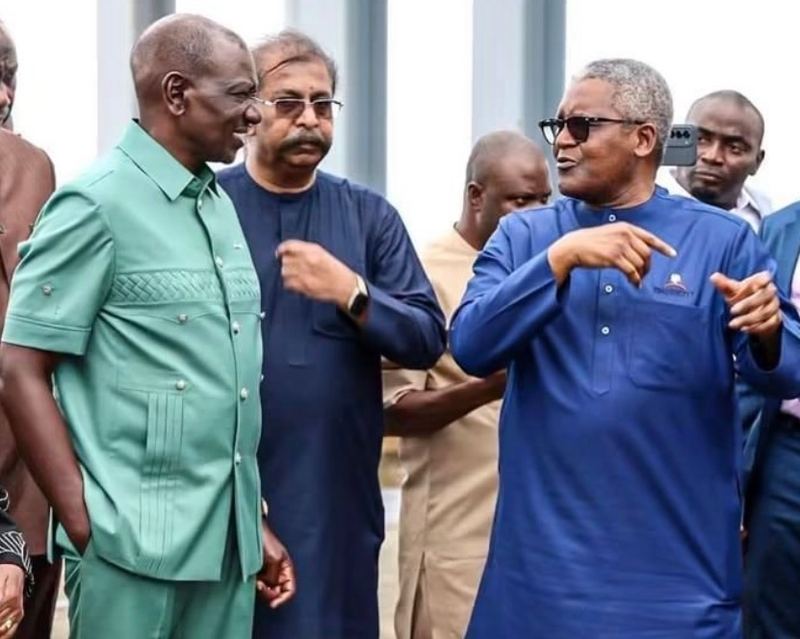
President William Ruto and Nigerian industrialist Aliko Dangote are scheduled to break ground on the East Africa Refinery in Lamu, a proposed 700,000-barrel-per-day petroleum refinery and petrochemical complex on LAPSSET land.
Government officials put the project's value at Sh2.2 trillion, which would make it the single largest industrial investment in Kenya's history and East Africa's largest refinery. The first consignment of equipment, 2,930 tonnes of machinery, arrived at Lamu port on 26 September, four days before the ceremony.
For the Consumers Federation of Kenya (COFEK), the scale of this project, and its potential effect on fuel prices, public finances and consumer protection, demands scrutiny that goes beyond the ceremony. The official pitch
Government messaging has centred on jobs and energy security. Deputy President Kithure Kindiki has put the jobs figure at more than 50,000, with government projections reaching 60,000.
Officials describe the refinery as a shield against global oil-price shocks, citing recent disruptions linked to the Strait of Hormuz, and as the turning point that moves Kenya from a fuel importer to a regional fuel exporter. These are legitimate consumer benefits, if delivered. COFEK's concern is not with the ambition.
It is with how many of the conditions for delivering it safely and affordably remain unmet just days before the state commits Kenya publicly and financially. Who owns it, and who carries the risk?
Dangote Group has offered Kenya, Ethiopia and Rwanda a combined 30% equity stake in the refinery, with Kenya weighing a 10% share worth roughly $500 million and the full regional package totalling about $1.5 billion.
In practice, this means Kenya is being asked to guarantee, alongside Ethiopia and Rwanda, that a share of the refinery's output will be bought regardless of market conditions, before construction has even started. Yet basic ownership disclosure is still contested. Kiharu MP Ndindi Nyoro has publicly demanded that the refinery's shareholders be disclosed, days before groundbreaking, warning against pressuring investors to surrender shares to political interests.
For consumers who will ultimately absorb any offtake shortfall through public finances or fuel pricing, knowing who benefits from the deal is not a technicality. It is a right. The financing and feedstock gap
Kenya has no producing oilfield to feed this refinery. Turkana's Lokichar discoveries remain undeveloped, and no pipeline currently exists to move crude from the interior to Lamu.
As of 26 September 2026, no binding Africa Finance Corporation commitment to the Kenyan project has been publicly announced, and financing remains under discussion, with no financial close reached. This stands in contrast to Dangote's Lagos refinery, where AFC led a $2.5 billion private placement completed in August 2026, a concrete institutional commitment Lamu has yet to secure. Debt financing for Lamu is estimated near $11.2 billion, still to be syndicated.
For a project this size to proceed on ambition rather than secured supply, storage and finance is a risk consumers did not choose and cannot easily exit.
Lamu's own record on consultation
Lamu is not a blank industrial canvas for Kenya's state. In May 2018, the High Court awarded 4,734 Lamu fishermen Sh1.76 billion in compensation for the earlier Lamu port project, after finding the government had failed to meet its own Environmental Impact Assessment licence and had violated the fishermen's traditional rights.
It took six years for that compensation to be paid in full.
That history is now shadowing the refinery.
Greenpeace Africa has signalled it is considering legal action over the project's environmental approval process. On 14 July 2026, it formally asked government to suspend all regulatory approvals until an independent Environmental and Social Impact Assessment (ESIA) is completed, published and subjected to public scrutiny.
Lamu Old Town is also a UNESCO World Heritage-listed site, adding further legal and reputational exposure if consultation is rushed. The process a deal this size requires A Sh2.2 trillion commitment involving land, cross-border equity and binding offtake guarantees should trigger more than a ministerial ceremony.
It touches at least the Petroleum Act, the Energy Act, the Environmental Management and Coordination Act, the Special Economic Zones Act, the Land Act and physical-planning law, alongside parliamentary oversight of the fiscal exposure involved. Debt syndication cannot close without a credible ESIA, and a credible ESIA depends on the kind of documented community consultation that the 2018 Lamu port ruling found the state had failed to provide the first time.
COFEK's position is that groundbreaking should follow, not precede, that sequence.
A regional pattern worth watching The Lamu offtake arrangement depends on Ethiopia and Rwanda honouring their side of a regional deal.
Kenya's recent track record on regional energy diplomacy gives reason for caution. In May 2026, Tanzanian President Samia Suluhu Hassan said she was unaware that President Ruto had announced a separate Dangote-linked refinery for Tanga, and said she had given no clearance for it.
Ruto later acknowledged publicly that the announcement had not sat well with Tanzanians. For consumers, the lesson is not about diplomatic etiquette. It is that regional commitments announced ahead of formal agreement can unravel, leaving Kenya to carry financial exposure that was assumed, not secured. COFEK's position COFEK does not oppose the Lamu refinery. Kenya's dependence on imported refined fuel is a real cost to households and industry, and a credible, well-run domestic refining capacity would serve consumers directly through price stability and supply security. What COFEK opposes is sequencing that puts a signing ceremony ahead of due diligence. Specifically, COFEK calls on the government to:
1 Publish the full ownership and beneficial-ownership structure of the refinery project before any binding offtake commitment is finalised.
2 Complete and publish the Environmental and Social Impact Assessment, with documented public participation in Lamu, before construction proceeds beyond preparatory works.
3 Table the project's fiscal exposure, including Kenya's proposed equity stake and any offtake guarantees, before Parliament for scrutiny and approval.
4 Secure and disclose binding feedstock, storage and financing commitments, rather than proceeding on projected timelines alone.
5 Learn from the Sh1.76 billion Lamu port compensation case by resourcing a transparent, pre-agreed compensation framework for any community affected by the refinery, before displacement begins, not after litigation forces it.
A project of this scale can genuinely benefit Kenyan consumers. It will only do so if it is built on disclosure, due process and enforceable guarantees, not on the momentum of a groundbreaking ceremony.
Filed underAliko, Dangote, Ruto, Lamu, Refinery, ESIA, Rwanda, COFEK