Eastleigh Building Collapse: The Government Agencies' Denials, Excuses and Professional Negligence Amidst Pain for Families of Victims
A multi-storey building under construction collapsed at about 1pm on Friday, 23 October, off Yusuf Haji Avenue, one of Nairobi's busiest commercial strips.
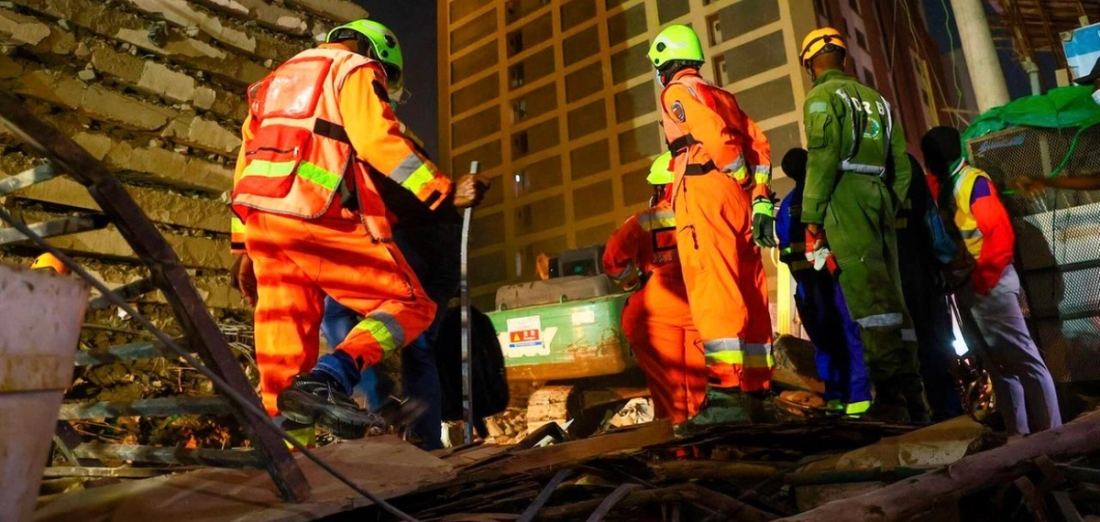
Nairobi, Kenya: At the Kenya Red Cross tracing desk on 9th Street, Eastleigh, the questions are simple. Is my brother alive? Has anyone seen my wife? Was my son in the basement shop when the floors came down?
The answers have been slow. The excuses arrived within hours.
A multi-storey building under construction collapsed at about 1pm on Friday, 23 October, off Yusuf Haji Avenue, one of Nairobi's busiest commercial strips.
By Saturday, Interior Cabinet Secretary Kipchumba Murkomen said all 67 construction workers had been accounted for, with between seven and eleven people still missing.
A man and a woman were pulled out alive and rushed to hospital for treatment in a major breakthrough. But that is the only good news.
The Red Cross had logged 31 missing-person reports, two since reunited with their families. Two injured people were taken to Kenyatta National Hospital. No confirmed death toll had been announced at the time of writing.
Even the basic facts are contested. Officials and media have described the building as 10, 13 and 18 storeys. Missing figures range from seven to 31. For families, this confusion is not a footnote. It is torment.
A chorus of “not us”
What has followed is a familiar Kenyan ritual: every agency explaining why the failure belongs to someone else.
Nairobi Governor Johnson Sakaja says the building had no occupation certificate, yet eleven shops in its basement and ground floor were trading.
He has been reported as saying county planners objected to the development in November 2024 and issued an enforcement order that was ignored. Other reports quote him saying the project had county construction approval. Which is it?
Either way, the question stands: if the county knew the building was irregular, why was it still rising, and why were shoppers inside?
Rather than answer, the Governor asked for more powers, including legal changes so counties can prosecute rogue developers and city courts can hear such cases.
Cofek does not oppose stronger enforcement tools. But an enforcement order that nobody enforces is not a legal gap. It is a performance gap.
The National Construction Authority (NCA) confirmed the project was registered on 30 July 2025. It named 9th Street Plaza Limited as developer and Stromax Holdings E.A Limited as contractor, alongside the architect and structural engineer on record.
It did not say whether the site was ever inspected, and it has not attributed fault to anyone. Officials were quick to stress that NCA registration is not county approval.
That is precisely the problem: two regulators, two sets of paperwork, and a high-rise that slipped between them.
CS Murkomen cautioned against conclusions on structural causes before investigations end. Fair enough. But caution about the cause must not become cover for the regulatory breakdown that preceded it.
Professional negligence cannot hide in rubble
Buildings do not fall on their own. Somebody designed this one, somebody certified its plans, somebody poured its concrete, and somebody let tenants in.
The vice president of the Institution of Engineers of Kenya, speaking at the scene, said there had been warning signs.
Survivors have described cracks and panic minutes before the collapse. If cracks were visible, who saw them, and who chose to keep working?
Police have launched a manhunt for the owner, who had not presented himself by Friday evening. Nairobi's regional police commander says those who authorised the construction will also be charged.
Cofek welcomes this and will hold the State to it. Past collapses produced similar vows, followed by quiet files and forgotten families.
On 2 January this year, a 14-storey building in South C collapsed, killing two guards; NCA admitted it was non-compliant. Where is that case today?
The risk is national. A National Building Inspectorate audit found 87 per cent of buildings checked nationwide last year failed to meet standards or lacked approvals. In that environment, Eastleigh was not bad luck. It was a predictable outcome.
Cofek Demands
The families need help now and answers soon. Cofek calls for:
- One verified, regularly updated list of the missing and injured, issued by a single lead agency.
- Immediate financial and psychosocial support for affected families and traders who lost livelihoods.
- Public release of every approval, enforcement notice and inspection record for the site, from both Nairobi County and NCA.
- Urgent review by the relevant professional registration boards of everyone on record for the project, without prejudging guilt.
- Personal accountability, not mere transfers, for any public officer who received or sat on warnings.
- An independent, published audit of high-rise construction in Eastleigh and similar dense zones.
Eastleigh's traders and residents are consumers of space: the shops they rent, the streets they walk, the buildings they trust not to fall on them.
They paid rent, fees and taxes on the assumption that someone was checking. That trust has been betrayed.
As rescuers keep digging, the least those in authority can do is stop explaining and start answering.
— Consumers Federation of Kenya (Cofek)
Filed underEastleigh, Nairobi, Collapsed, Building, County, NCA, NEMA, COFEK