Devil in the Detail: Questionable Contract of How the $44 for Inbound Travel Insurance is Shared Out
Serious mischief in the Ministry of Health controlled inbound travel insurance charged at $44 per traveller - led by Minet Re and Kenbright Re collected by eCitizen ends up in private pockets through DHA as an unexplained conduit
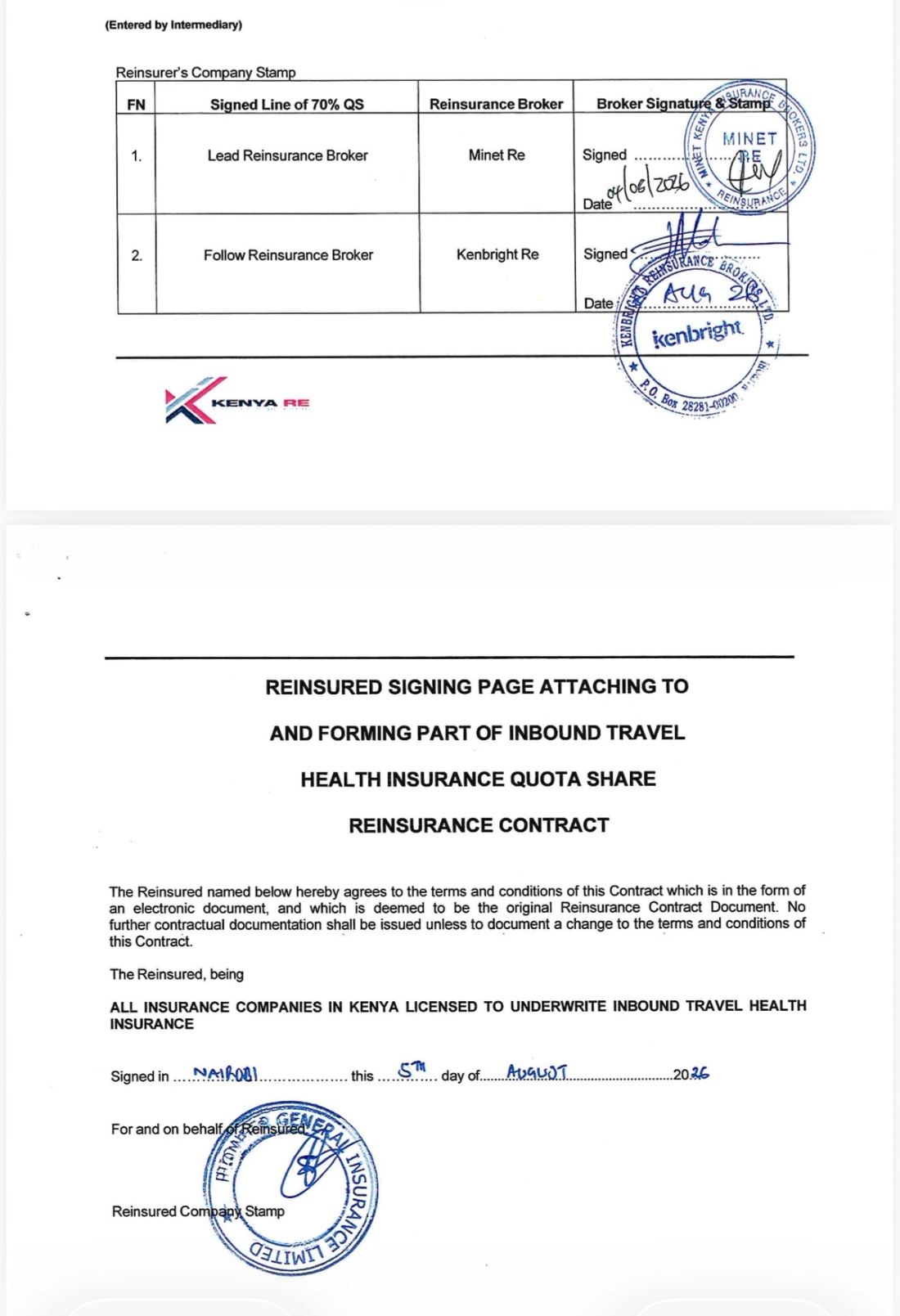
We have analyzed the Kenya Reinsurance contract with Minet Re And Kenbright Re (ownership search “restricted” on e-citizen). In summary, the premium waterfall (per $44 policy) alloys the cake as follows;
• eTA System Charges: $3.00 (6.8%) — flat state portal fee • Digital Health Agency (DHA)Fee: $16.40 (37.3%) — the single biggest slice, taken off the top, before “risk premium” is even calculated. Again, for doing nothing but as a conduit to benefit several honchos in government • Administration Fee: $7.38 (16.8%) — 30% of what’s left after DHA • Reinsurance Brokerage: ~5% of ceded premium (Minet/Kenbright) — additional layer not even shown in the visible waterfall • Subtotal to non-risk-bearing intermediaries: ~$27+ (over 60% of gross premium) before a single shilling is earmarked to pay a claim • What’s left ($17.22, “Net Premium”) is then split 70/30 between Kenya Re’s pool and the original underwriter • Claims Fund carve-out: 40% of the underwriter’s retained share is stripped out to the Kenya Re-administered pool • Underwriter’s own retained margin: $3.10–$4.31
The mischief as it is revealed in the contract:
1. Risk-bearers get the smallest cut. The two parties who actually stand behind claims — the original insurer (30% quota) and Kenya Re (70% quota) — together are left with roughly 38% of gross premium to fund a $50,000 annual aggregate benefit. Everyone else (DHA, administrator, eTA system, brokers) is paid off the top regardless of loss experience, before underwriting even happens.
2. Digital Health Agency (DHA) 40% cut has no clear insurance-law basis. DHA is described as a data/health-identity/emergency-coordination system, not an insurer, broker, or reinsurer under the Insurance Act.
Yet it extracts the largest single share of a compulsory insurance premium ahead of the risk pool itself. What statutory instrument authorizes DHA to price itself as a percentage of premium rather than a fixed service fee for system access?
3. Compulsory collection via a state gateway (eTA/e-Citizen), private beneficiaries.
If every inbound traveler is compelled to buy this as a condition of entry, and the money is collected through the government’s own eTA portal, that starts to look like a quasi-tax collected by the state and largely disbursed to non-state fee-takers (DHA, MKC as claims administrator, brokers) — without the transparency, appropriation, or procurement trail you’d expect for public-fund flows under the PFM Act.
Was DHA competitively procured, or is this a sole-source concession riding on the back of mandatory travel insurance?
4. Actuarial adequacy is questionable. Only $17.22 of the $44 (39%) ever becomes “risk premium” feeding the claims-paying pool, against a promised $50,000 annual aggregate and sub-limits like $25,000 for medical evacuation.
With 6,500 daily visitors and roughly 50% uptake assumed in the projections, the fund’s real claims-paying capacity is being tested against a premium base that’s already lost 61% of its value to fees before underwriting starts.
5. Consumer has no bargaining power or choice. This is a captive market — visitors can’t shop for a better-priced policy or opt out of the DHA/admin fee stack, which is the classic fact pattern for an “unconscionable term” challenge under the Consumer Protection Act, especially where the fee structure isn’t disclosed to the actual insured (the traveler) anywhere in the visible policy documentation.
6. Overriding Commission is nil on profit but 10% flat on ceded premium — meaning the intermediary layer is guaranteed income even in a loss year, while the underwriter’s $3.10 margin has to absorb any adverse claims experience on its retained 30% share.