Why COFEK Is Fighting the Government's Proposed Minimum Fare for Taxi-Hailing Apps
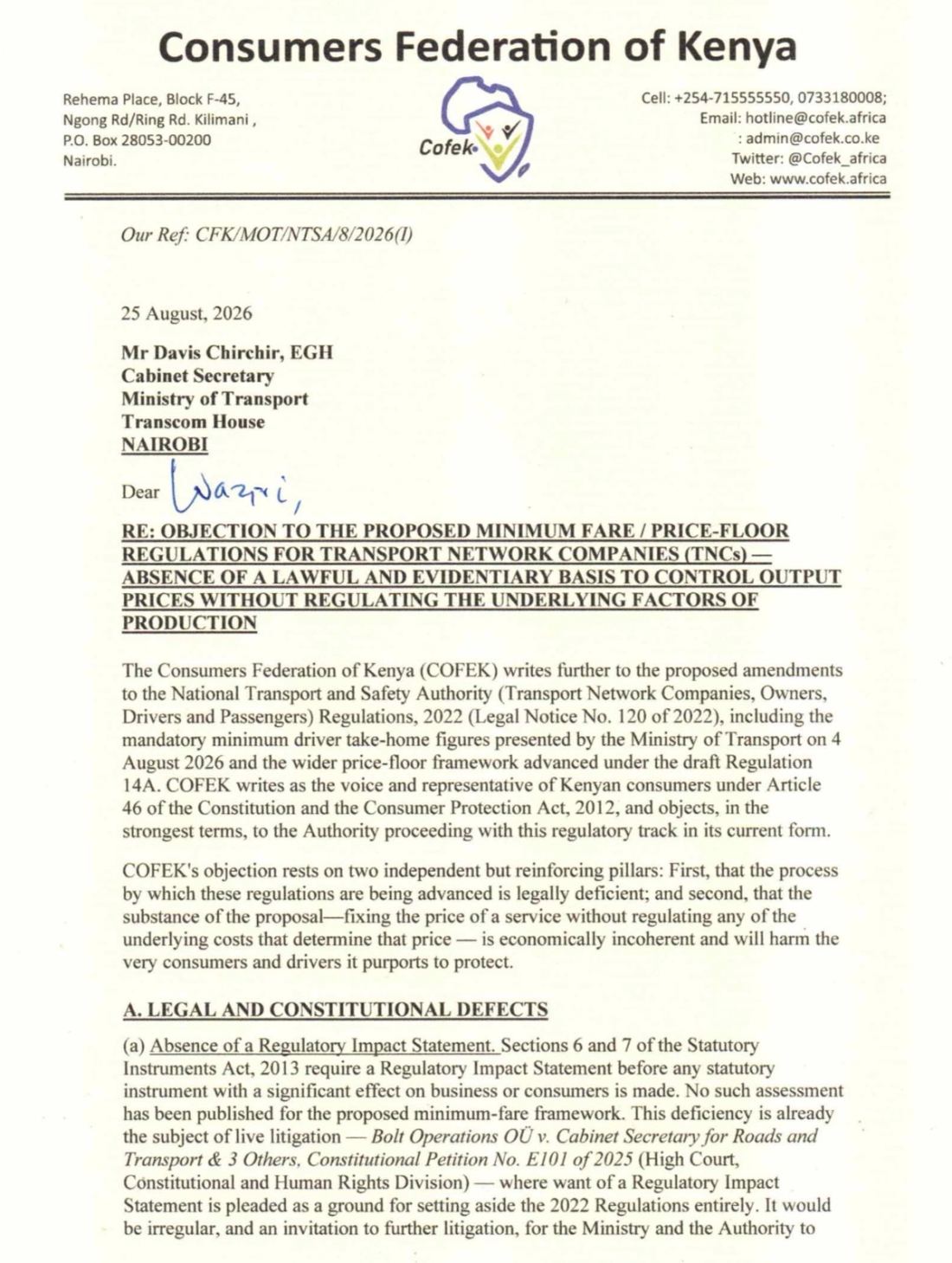
On 4 August 2026, Cabinet Secretary Davis Chirchir's ministry unveiled mandatory minimum driver take-home figures, part of a wider price-floor framework being pushed into the National Transport and Safety Authority (Transport Network Companies, Owners, Drivers and Passengers) Regulations, 2022 through a new Regulation 14A.
The Ministry of Transport wants to set a floor under what Bolt, Uber, Little Cab, Glovo and InDriver can charge Kenyans for a ride.
On 4 August 2026, Cabinet Secretary Davis Chirchir's ministry unveiled mandatory minimum driver take-home figures, part of a wider price-floor framework being pushed into the National Transport and Safety Authority (Transport Network Companies, Owners, Drivers and Passengers) Regulations, 2022 through a new Regulation 14A.
The Consumers Federation of Kenya (COFEK) has now written to Mr Chirchir objecting, in the strongest terms available to it, to the Authority proceeding with this regulatory track in its current form.
The federation's case rests on two pillars: that the process behind the regulations is legally deficient, and that the substance — fixing the price of a service while leaving every cost that determines that price to float freely — is economically incoherent and will hurt the very consumers and drivers it claims to protect.
A process already under a cloud: COFEK's first objection is procedural. Sections 6 and 7 of the Statutory Instruments Act, 2013 require a Regulatory Impact Statement before any instrument with a significant effect on business or consumers is made.
None has been published for the minimum-fare framework — a gap that is already the subject of live litigation. In Bolt Operations OÜ v. Cabinet Secretary for Roads and Transport & 3 Others, a petition pending before the High Court's Constitutional and Human Rights Division, the absence of a Regulatory Impact Statement is pleaded as grounds to set aside the 2022 Regulations entirely, with a ruling expected in September 2026.
COFEK argues it would be reckless for the Ministry to layer new price controls onto a regulatory instrument whose own validity is sub judice.
The federation also says the public participation carried out so far excludes the one party that pays for all of it: the consumer.
On COFEK's reading, the process has consulted the Ministry, NTSA and driver representatives, and has taken written feedback from the platforms themselves, but has not meaningfully engaged the passengers who fund the entire ecosystem through their fares.
COFEK argues that this falls short of the public participation Article 10(2)(a) of the Constitution requires of every state organ exercising delegated legislative power.
Beyond process, COFEK questions whether NTSA has the legal authority to do this at all.
The Authority's statutory functions run to road safety, licensing and regulation — not to fixing prices or wages in a private commercial market, which the federation says belongs to labour or competition law, not a road-safety regulator's subsidiary legislation.
It further argues the draft regulations single out TNCs for price control while leaving matatus, boda bodas and street-hail taxis — competing for the same passenger trips — free to price on market terms, a distinction COFEK calls presumptively arbitrary under the equal protection guarantee in Article 27, and one the Ministry has not justified.
A blanket price floor that ignores trip distance, duration or actual driver costs is, in COFEK's words, a blunt instrument disproportionate to the constitutional protections for property and contractual freedom in Articles 24 and 40.
The federation also flags that the draft extends the framework to courier and delivery hailing, activity already regulated by the Communications Authority of Kenya — double regulation of the same service by two regulators under two different standards.
The economics: You cannot fix the price and ignore the costs
COFEK's central objection, though, is one of basic regulatory logic. A driver's net take-home is what is left after fuel, vehicle financing and interest, spare parts, maintenance, insurance and the platform's commission are deducted from the fare.
NTSA does not regulate fuel prices, bank lending rates, the cost of spare parts, vehicle import costs or road and charging infrastructure.
Mandating a minimum output price while every input cost floats freely, the federation argues, does not guarantee any particular driver income — it simply guarantees a higher price for the passenger, with no corresponding guarantee for the driver once input costs move.
COFEK points to the Ministry's own 4 August proposal as proof of the point: it was not well received by drivers, which it takes as evidence that fare increases divorced from the underlying cost structure do not resolve the grievance and will only trigger repeated rounds of renegotiation.
Kenya already runs an 18 percent statutory commission cap on ride-hailing platforms, believed to be the only one of its kind in the world.
Stacking a mandatory price floor on top of that cap, COFEK says, regulates the same transaction from both ends, squeezing the margin platforms have to invest in technology, safety and driver incentives — at a time when comparator markets including South Africa, India, the United Kingdom and the United States regulate safety and consumer protection but leave fare-setting to the market.
What the data show: COFEK's letter marshals figures it says argue for caution rather than a fresh, unresearched intervention.
Industry estimates put the ride-hailing and delivery sector's contribution to the Kenyan economy at over KSh 50 billion a year, supporting an estimated 40,000 drivers and couriers in Nairobi alone.
KRA's own submission to the National Assembly's Departmental Committee on Transport and Infrastructure records that Bolt, Uber, Little Cab, Glovo and InDriver together remitted about KSh 8.2 billion in Digital Service Tax, VAT and Corporation Tax in FY2022/23, falling to roughly KSh 7.86 billion in FY2023/24 — a year-on-year decline COFEK says should itself be investigated before the sector is hit with a further demand-suppressing measure.
A shrinking marketplace driven by an artificial price floor would squeeze that tax base further, with knock-on effects for vehicle financing, fuel retail and insurance.
Independent polling by TIFA Research of the Nairobi public, conducted 17–21 July 2026 with 733 respondents, found 81 percent already very concerned about the cost of living, and 59 percent calling a mandated minimum fare "the wrong policy," against 39 percent in support.
The two leading reasons cited were that fares should be market-determined and that the policy would make rides more expensive.
Only 27 percent of ride-hailing users were even aware the policy was under consideration before being surveyed — which COFEK cites as further evidence of the consultation gap.
The same survey found that if fares rose significantly, 44 percent of respondents would shift to matatus, 11 percent to boda bodas, and a further 11 percent would cut their use of ride-hailing altogether — displacement COFEK warns would push trips into less regulated, less safe and less traceable channels, undermining the very passenger-safety mandate NTSA exists to serve, and eroding the trip volumes any higher driver take-home would have to come from.
COFEK also notes, without adopting it uncritically given its interested source, an industry estimate that the fare floor could remove roughly KSh 20 billion in annual economic activity.
What COFEK is demanding: COFEK has asked the Authority to suspend further processing of the draft amendments, including Regulation 14A, pending a compliant Regulatory Impact Statement; to await the High Court's ruling in the Bolt petition before advancing amendments to an instrument whose validity is already before the court; to run a fresh round of public participation that specifically and visibly includes consumer and passenger representatives, not only drivers, platforms and officials; to redirect regulatory attention to the actual cost drivers behind driver earnings — fuel pricing, vehicle financing and interest rates, spare parts, vehicle imports and infrastructure — rather than a blanket output price that leaves those untouched; and to align this workstream with the broader National Taxi Policy currently being developed with World Bank support, so Kenya's approach to digital mobility is coherent rather than fragmented and reactive.
COFEK says it remains available to engage constructively on an evidence-based framework that protects driver welfare without imposing an unjustified, regressive cost on Kenyan consumers — particularly lower-income, high-frequency commuters already under acute cost-of-living pressure, on the Authority's own data.
But the federation has put the Ministry on notice: should its legal and economic objections be ignored or only partially addressed, COFEK says it will have no option but to move to court.
COFEK's letter, dated 25 August 2026, was copied to the Attorney General, the Director General of NTSA, and the Clerk of the National Assembly.