New Police Uniforms Unveiling Deeply Muddied in Procurement Scandal
If NPS wants this controversy to actually die rather than simply go quiet, the remedy is straightforward: publish the tender advertisement, the technical evaluation scores for Bedi Investments and Rivatex East Africa, the professional opinion of the procurement committee, and the signed contract with Bedi Investments, including value and delivery timelines.
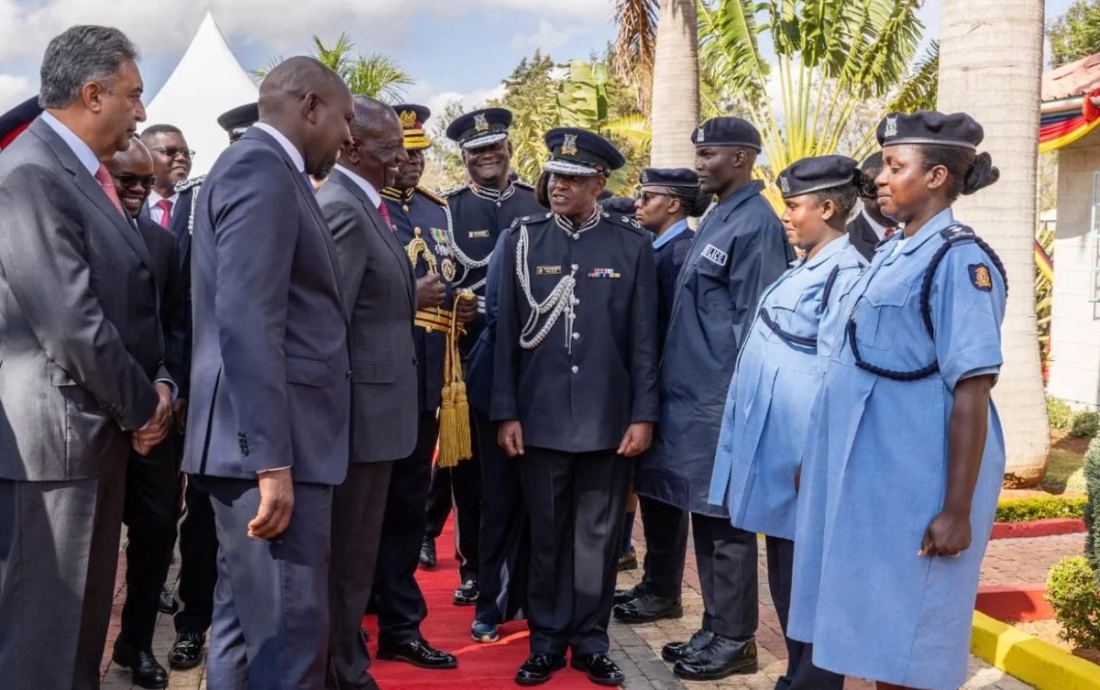
The rollout of Kenya’s new police uniform — meant to symbolise a fresh chapter in the police reform agenda — has instead been overshadowed by a procurement controversy that the National Police Service (NPS) is now scrambling to contain. In a same-day press statement issued on August 30, 2026, the Office of the Inspector General moved to distance itself from claims linking the uniform contract to an entity identified in media reports as Nalitex Limited.
The NPS insists the firm “does not feature anywhere” in the process of developing, selecting, procuring or manufacturing the new General Duty uniform, and has “received no purchase order or payment” from the Service. According to the statement, the uniform change traces back to the Maraga Task Force on Police Reforms, chaired by retired Chief Justice David Maraga, which found that officers overwhelmingly wanted a different look and recommended reverting to earlier uniform colours.
The Kenya Police Service Uniform Committee subsequently worked with the Kenya Bureau of Standards (KEBS) to set specifications, after which four Kenyan textile manufacturers — Bedi Investments, Rivatex East Africa, Thika Textile Mills, and Sunflag Textiles & Knitwear Mills — were invited to submit samples “in the spirit of Buy Kenya, Build Kenya.” Only two firms, Bedi Investments and Rivatex East Africa, submitted samples within the stipulated timeline.
Following evaluation and what the NPS describes as “public participation,” Bedi’s sample was adopted, and the company was subsequently awarded the manufacturing contract under the Public Procurement and Asset Disposal Act, 2015. Where the story gets murky: The NPS calls the media association with Nalitex Limited “false and malicious” — strong language for a statement meant to project calm.
But strong denials are not the same as documentation. Nowhere in the two-page release does the Service publish the actual procurement record: no tender advertisement reference, no evaluation report, no scoring matrix, no signed contract or award letter naming Bedi Investments as the successful bidder. For an institution insisting its process was “clear and documented,” the clarity stops at the level of narrative.
Kenyans are being asked to accept, on the Service’s word alone, that a named company played no role — without the paper trail that would settle the question definitively.
In an environment where police procurement has repeatedly attracted scrutiny — from body cameras to vehicles to now uniforms — a press statement is a weak substitute for primary documents. A pattern too familiar: The timing is also notable. The statement is dated the same day media reports apparently broke, suggesting a rapid-response posture rather than proactive disclosure.
Public institutions that get ahead of scandal by publishing procurement files as a matter of course rarely need same-day rebuttal statements.
NPS’s approach here — assert innocence, name the “correct” contractor, declare the other entity’s involvement “false,” and close with boilerplate commitment to “transparency, accountability and the responsible use of public resources” — follows a familiar script in Kenyan public procurement disputes: deny first, disclose later, if at all. What should happen next: If NPS wants this controversy to actually die rather than simply go quiet, the remedy is straightforward: publish the tender advertisement, the technical evaluation scores for Bedi Investments and Rivatex East Africa, the professional opinion of the procurement committee, and the signed contract with Bedi Investments, including value and delivery timelines.
Parliament’s relevant committees and the Public Procurement Regulatory Authority should also independently verify the claims made in the statement rather than take them at face value.
Until that documentation is public, the NPS’s rebuttal — however forcefully worded — remains an assertion, not proof. And in matters of public money and public trust, assertions are not enough.