Health Interns’ Strike Threat Exposes Kenya’s Broken Promise Machine on Salaries
The Kenya Medical Practitioners, Pharmacists and Dentists Union (KMPDU) now says full payment is expected by September 2.
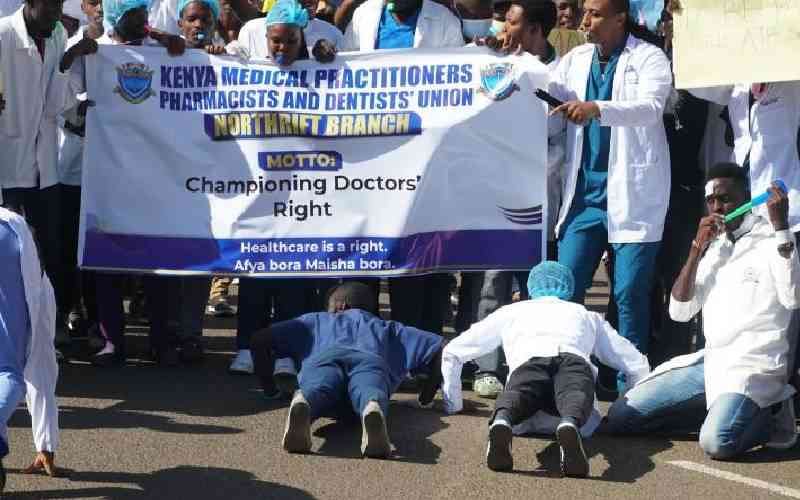
Kenya’s public health system is once again bracing for disruption after thousands of medical interns — doctors, dentists, pharmacists, nurses and clinical officers — issued notice that they will down tools from August 31, 2026, over salaries the Ministry of Health had promised to pay by July 25.
For patients who depend on public hospitals, this is not an abstract labour dispute.
It is the latest instalment in a pattern where the people staffing Kenya’s wards are forced to threaten industrial action before the state honours its own commitments.
The timeline is instructive. When the Cabinet Secretary for Health Aden Duale flagged off the current cohort of interns, the Ministry gave a firm date: salaries by July 25, 2026.
That date came and went.
By late August, with interns still unpaid, unions moved to formal strike notice, submitted to the Ministry and internship centre managers across the country, including Kenyatta National Hospital, Moi Teaching and Referral Hospital, Jaramogi Oginga Odinga Teaching and Referral Hospital and Mwai Kibaki Referral Hospital. Only then — days before the strike deadline — did the State Department for Public Health confirm that payroll integration had been completed on August 28, with salaries expected to start reflecting from September 1.
The Kenya Medical Practitioners, Pharmacists and Dentists Union (KMPDU) now says full payment is expected by September 2.
In other words: it took the credible threat of thousands of interns walking off hospital floors to unlock a payment process the Ministry had already promised, in writing, over a month earlier.
This is not an isolated administrative hiccup. It is part of a wider, recurring failure in how the state funds and pays its frontline health workforce.
Earlier this year, in July 2026, KMPDU threatened a separate nationwide strike over delayed salary adjustments for doctors across all 47 counties, after the Salaries and Remuneration Commission had already approved revised pay notches and the Ministry of Public Service had confirmed the payroll system was cleared to process them.
The union’s assessment then was blunt: there was “zero justification” for further delay. By August 10, health workers in Migori, Homa Bay, Kisii, Nyamira, Kisumu and Embu counties were already on strike over pay, promotions and job security — a dispute that has since deepened into a broader standoff over how Kenya’s devolved health system is financed.
This is not a new phenomenon either; intern stipend delays and strike threats have recurred with grim regularity since at least 2024, each time resolved only after public pressure or the eleventh-hour release of funds.
For consumers of public healthcare — which is to say, the ordinary Kenyan patient — the pattern matters more than any single dispute.
Every strike threat, however briefly resolved, means delayed procedures, unattended wards, overstretched senior staff covering for absent interns, and a health system that operates on a cycle of crisis-then-concession rather than reliable planning.
The Ministry’s own admission that payroll integration only concluded on August 28 — three days before the scheduled strike, and more than a month after the promised payment date — suggests the delay was administrative and foreseeable, not the product of some unavoidable shock.
That is precisely the kind of institutional failure that erodes public trust: a government department setting its own deadline and then missing it without consequence, until those owed money organise to make missing it costly.