Miracle in Thika: Mother Delivers Five Healthy Babies Naturally, and Kenya's Public Hospitals Deserve Some of the Credit
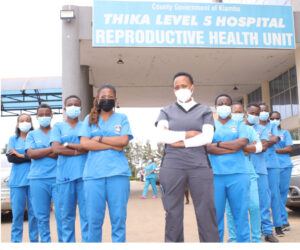
Behind the headline is a medical team that deserves its own recognition. Hospital sources indicate that nurses at Thika Level Five spent close to eleven consecutive hours on their feet managing the delivery and the immediate care of five newborns, each requiring simultaneous monitoring for the low birth weight and prematurity risks that come with any multiple pregnancy.
On Sunday, 13 September 2026, at around 10 a.m., Mercy Kanini walked into Thika Level Five Hospital in Kiambu County and, within hours, walked out into the history books.
Kanini delivered five babies — quintuplets — through normal vaginal delivery, without a single incision, in what doctors and public health officials are calling one of the rarest obstetric events recorded in Kenya.
Only four other quintuplet births have ever been documented in the country since 1997, and Kanini's is believed to be the first delivered entirely by natural birth rather than Caesarean section. The scale of the rarity is worth sitting with. Natural conception of quintuplets, without any fertility treatment or IVF, happens in roughly one in 55 million pregnancies. Carrying such a pregnancy safely to term is itself an achievement most obstetricians will never witness in an entire career.
Delivering all five babies vaginally — normally considered so risky to both mother and infants that doctors almost universally opt for a planned Caesarean section — is rarer still. In Kanini's own words, spoken from her hospital bed and relayed in Swahili to reporters who gathered at Thika Level Five: "Vile nilifika hapa kuna mtoto alikuwa ametangulia kutoka, vile nilisikia anatoka niliita daktari akaniweka labour ward akaniangalia akiprocess kuenda theatre, but after sometime wakasema naweza deliver normal."
Loosely translated: by the time she reached the hospital, the first baby was already beginning to arrive. Doctors moved quickly to prepare her for theatre for a C-section — the standard, safest protocol for a multiple birth of this magnitude.
Then, after a further examination, the plan changed. She was told she could deliver normally. She did — all five.
Kanini, from Juja, had gone into the pregnancy expecting quadruplets. The fifth baby, she said, was a complete surprise, discovered only as labour progressed.
Her husband, Evans Murirya Nyahanga, spoke to journalists with a mixture of joy and quiet apprehension that any parent of newborn quintuplets would recognise. "Kwa majina ni Evans Murirya Nyahanga, niko na furaha kujaliwa na watoto watano, hii jambo ni ngumu tena ni furaha," he said — happy to have been blessed with five children, but honest that the road ahead will not be easy.
He appealed directly to Kiambu Governor Kimani Wamatangi and to anyone willing to stand with the family as they take on the extraordinary cost of raising five infants at once. Behind the headline is a medical team that deserves its own recognition. Hospital sources indicate that nurses at Thika Level Five spent close to eleven consecutive hours on their feet managing the delivery and the immediate care of five newborns, each requiring simultaneous monitoring for the low birth weight and prematurity risks that come with any multiple pregnancy.
Governor Wamatangi publicly commended the medical team, noting that the delivery has placed the county referral hospital in the national spotlight — for entirely the right reasons. That spotlight matters to COFEK, and it should matter to every Kenyan who relies on a public facility rather than a private one when it counts most.
For years, the conversation around Kenya's referral hospitals has too often centred on what goes wrong — stockouts, understaffing, long queues, and patients turned away or referred elsewhere for want of specialist capacity.
Thika Level Five's handling of one of the rarest and highest-risk deliveries in Kenya's obstetric history is a reminder of what public healthcare, properly staffed and properly equipped, is capable of delivering to an ordinary family from Juja who could never have afforded a private specialist team for a pregnancy of this complexity.
That is precisely the kind of outcome that public investment in county referral hospitals is supposed to produce, and it deserves to be said plainly when it happens. It should also prompt a harder, more practical question: what happens now?
Five newborns, all requiring close neonatal observation in the weeks ahead, represent a level of ongoing medical, nutritional and financial need that no family — however resilient — can be expected to absorb alone.
COFEK joins Mr Nyahanga's appeal to the Kiambu County Government, the Social Health Authority, and well-wishers to ensure that the Kanini-Nyahanga family receives sustained support long after the cameras have left the maternity ward: guaranteed follow-up neonatal care, nutritional support as the babies grow, and financial relief for a family that has, almost overnight, quintupled in size. Mercy Kanini's delivery will be remembered as a medical rarity. It should also be remembered as evidence of what Kenya's public hospitals can achieve when skilled personnel, sound clinical judgement, and quick decision-making come together under pressure.
As COFEK continues to advocate for the rights and welfare of Kenyan consumers of public services, including healthcare, this is a story worth celebrating — and a reminder to keep investing in the referral hospitals that ordinary families depend on for their most vulnerable moments.
Congratulations to Mercy Kanini, Evans Murirya Nyahanga, and the five newest members of their family.
And congratulations, too, to the doctors and nurses of Thika Level Five Hospital, who proved, over eleven long hours, exactly why that investment matters.
Filed underThika, Referral, Hospital, Quintuplets, Kenya, Cofek